30 Spring Books for Preschoolers

Spring is such a wonderful time of the year. The weather is warm and kids are outside playing. My family and I love to go on nature walks to see the tadpoles evidently turn into frogs. My son loves to throw rocks in the water and fly his kite.

To prepare my son for spring, we start reading books about the season near the end of winter. There are countless books that will teach your child about the lifecycle of various animals, plants, and what happens to the earth during spring time.

It is wonderful to absorb the rich information in these books. However, I encourage you to couple your reading with actually experiencing spring.

Below is a video of the Walking Water Experiment. It is a great activity to teach kids how plants get water through capillary action starting in Spring. The video comes from my son’s YouTube channel called Corban’s Fun Learning Adventures. Please like and subscribe!

Below I will give you 30 spring books for preschoolers.

Let’s get started!

Little Mole is sad. Therefore, his mother teaches him about hope by leading the way out of their dark burrow into a bright world filled with the promise of spring.

Count the 10 little rubber ducks as they swim downstream on a spring day. This book has hatching chicks, a hopping bunny, blossoming flowers, and more spring-time scenes.

On a sunny springtime day, siblings Feather, Flap, and Spike set out to explore the many flowers, leaves, and seeds outside. Their day is met with difficultly by Spike’s dino-sized sneezes.

Easter is almost here and Turkey knows just how to celebrate. He’s going to win the eggstra-special Easter egg hunt! The only problem is that animals aren’t allowed to enter. What will he do?

After the cold of Winter, comes the warmth of Spring. I Am Spring takes young children on a journey through the many important events that occur uniquely in the beautiful growing season of Spring.

Celebrate the season of spring with raindrops, robins, bluebells, and butterflies! This book has colorful illustrations and are matched with rhyming, easy-to-read text that explores rain falling, flowers blooming, and other springtime wonders.

When spring comes, leaves unfurl and flowers blossom, the grass turns green, and the mounds of snow shrink. Spring brings baby birds, sprouting seeds, rain and mud, and puddles. You can read all about it in the book!

Join in the rainy-day fun, as kids splash through the puddles, affecting another weather enthusiast, a nearby worm. An imaginative and playful story, readers will love seeing the worm delight in the weather just as much as the kids.

Mole can smell that spring is in the air, but Bear is still asleep after his long winter nap! Excitedly he taps on the window and knocks on the door. He even tries playing a trumpet to wake his friend so they can celebrate together.  However, bear keeps snoozing.  

As days stretch longer, animals creep out from their warm dens, and green begins to grow again, everyone knows―spring is on its way! Join a boy and his dog as they explore nature and take a stroll through the countryside, greeting all the signs of the coming season.

Young children will enjoy learning about colors and flowers while reading this book.

This story is about the life cycle of a flower and is told through the adventures of a tiny seed. It includes a detachable seed embedded paper housed on the inside front cover.

Flitzy the butterfly welcomes back the plants and animals of spring! This book has rhymes and colorful illustrations that will delight young readers! 

The adorable baby animals in this book are fun to view and they represent life that is spring. Every young creature finally ventures outside to play as the days of winter fade away and color surround us all. 

In spring, seeds are planted and sprouts pop up through the soil. Colorful flowers bloom. Your child will see how plants come to life in spring.

Children will explore spring in the forest with this interactive Lift-a-Flap Surprise board book! Little ones will love learning all about springtime fun in the forest while following a mama deer and her sweet little fawn.

Your children will hear the forest is calling. They will also take a quiet walk through the woods, where shadows fall in the darkness, eyes peek out, and some animals sleep while others run and leap.

Up in the garden, the world is full of green. Down in the dirt there is a busy world of earthworms digging, snakes hunting, skunks burrowing, and all the other animals that make a garden their home. Children will discover all the wonders of spring.

This story helps children understand the change of seasons, the excitement of hiking, and the importance of what it means to “leave no trace.”

Ladybugs, butterflies, daddy longlegs, and roly polies are just some of the familiar creatures featured in this book. This book also has an actual size bug chart, which provides real-world comparisons so that readers know exactly how big each bug is, and the Bug-O-Meter, which lists fun facts about each bug, such as number of legs, where it lives, whether it flies, and if it stings.

Bob and Otto are best friends. They love to eat leaves, dig, and play together. When the two meet again, Otto is still the same dirt-loving earthworm, but Bob has done the unthinkable: grown wings.

Gossie and Gertie are friends waiting for Ollie to hatch. They try poking, listening, even sitting on top of his egg but, Ollie just won’t come out.

A girl observes and describes birds—their sizes, their colors, their shapes, the way they move and appear and disappear, and how they are most like her. She imagines what it would be like if clouds looked like birds, or if she could ask the birds questions.

This book includes lots of easy, smart ideas on how we can all work together to make the Earth feel good. It discusses planting a tree, using both sides of the paper, saving energy, and reusing old things in new ways.

This picture book shows the incredible metamorphosis that occurs as a tadpole loses its fishy tail and gills and becomes a frog.

Mayumie and her grandmother take a trip into Tokyo to see cherry blossoms flowering in the heart of the city.

This book teaches kids to speak up and stand up for those who can’t. With a recycling-friendly “Go Green” message, The Lorax allows young readers to experience the beauty of the Truffula Trees and the danger of taking our earth for granted.

Come explore the amazing world of bugs with this book. The bugs in this book include hungry caterpillars, busy ants, and graceful dragonflies.

Little chick may be the smallest chick on the farm, but she doesn’t know it. What she does know is that she can chirp the loudest, eat the most, and stand the tallest.

Springtime is here, and Zinnia can’t wait to plant her seeds and watch them grow. She takes care of her garden by watering her plants, weeding, and waiting patiently for something to sprout. Soon, the first seedlings appear!

OUR KID FRIENDLY FAST & FUN STUDY TRICKS FOR BETTER GRADES: 9 FUN STRATEGIES FOR SUCCESS IN LEARNING AND SCHOOL HAS $29 OFF THE ORIGINAL PRICE.

Our books are available on Amazon, “Teach Your Toddler to Read Through Play,” “Fun Easy Ways to Teach Your Toddler to Write, and “Teach Your Child About Money Through Play.

THE TEACH YOUR TODDLER TO READ THROUGH PLAY ONLINE COURSE HAS A $97 DISCOUNT.

Click here for the PAYMENT PLAN OPTION!

How Reading Can Boost Children’s Working Memory

About two weeks ago, I took my son to the local library for a story time program. As I was walking, I passed by the book, The Working Memory Advantage: Train Your Brain to Function Stronger, Smarter, Faster by Tracy and Ross Alloway. This title immediately caught my attention because I love reading books on how to use the brain to its fullest capacity. I checked the book out and started reading it that night.

I learned so much from this book. One detail that stuck with me was the power of working memory. Did you know that it is more important than IQ? As always, I want to share what I learned with you and its benefits to young children.

Let’s Get Started!

One of best ways to improve working memory is to read. Working memory is one’s ability to process information. This means focusing on the information or making decisions about it. A person with great working memory can manipulate information and reformulate it.

Let’s apply this to children. If a child is in school or participating in an extracurricular activity with a group, working memory can help them inhibit distracting information, like their classmates whispering near them. It will also help them keep track of where they are in a multistep task. Furthermore, children with good working memory can access information, like numbers or words, to complete an assignment. It allows children to hold information in their mind and complete tasks quicker.

Other Ways Working Memory Helps Children

  • It helps children think fast on their feet.
  • Take smarter risks
  • Make smarter judgement calls
  • Adapt to new situations
  • Stay motivated to achieve long-term goals
  • Follow a moral compass like doing the right thing in social situations

Working Memory is Better than IQ

Have you noticed that many people with below average IQ scores became great business men and women, bestselling authors, or innovative inventors? IQ is not the best predictor of lifetime success, especially not in our current times.

Thanks to search engines like Google, we no longer need to rely on knowledge such as facts, dates, and names. These types of facts are associated with IQ. Intelligence today is measured by being able to put those facts together, organize the information, and do something constructive with it. IQ is what you know and working memory memory is what you can do with what you know.

The facts below about working memory versus IQ may be shocking to you…

  • A good working memory is the best advantage in school and is related to good grades.
  • Kids with good IQ scores don’t necessarily have good working memories.
  • An average or even high IQ does not necessarily give children the tools for success in the classroom and beyond.

So let’s see how reading can help children improve working memory

Reading requires working memory because you recall information, anticipate what is coming next, and interpret words and sentences. Challenge your child and boost their working memory by reading more difficult books and stories.

For Children Ages 2 to 5

  • Read aloud to children and challenge them by reading new stories.
  • For 2-3 year olds, ask them facts about the story.
  • This will make them use their working memory to review what they know about the story.
  • If you read to children at early ages, you’ll be surprised at what they can analyze and make sense of.
  • Ask your 4 year old to give their opinions on the motivations of the characters.
  • For example, ask your 4 year old the following question: Why do you think the character ignored their friend?
  • These types of questions will help your child stretch their speculations.
  • For 5 year olds, if they can read, ask them to read simple and short stories on their own occasionally.
  • If the 5 year old cannot read, ask them to picture walk.
  • Picture walk means to look at the images of the story and predict what it is about.
  • Bonus Tip: For children ages 6-10, read harder material to them.
  • In doing this, you will stretch their minds and the easier books they read on their own will seem less difficult.

I highly recommend purchasing or borrowing The Working Memory Advantage: Train Your Brain to Function Stronger, Smarter, Faster by Tracy and Ross Alloway from the library. It will open your mind to the brain’s many possibilities!

I hope this helps!

OUR KID FRIENDLY FAST & FUN STUDY TRICKS FOR BETTER GRADES: 9 FUN STRATEGIES FOR SUCCESS IN LEARNING AND SCHOOL HAS $29 OFF THE ORIGINAL PRICE.

Our books are available on Amazon, “Teach Your Toddler to Read Through Play,” “Fun Easy Ways to Teach Your Toddler to Write, and “Teach Your Child About Money Through Play.

THE TEACH YOUR TODDLER TO READ THROUGH PLAY ONLINE COURSE HAS A $97 DISCOUNT.

Click here for the PAYMENT PLAN OPTION!

Secret Message Activity for Kids

I am always looking for activities that incorporate reading and writing in a fun way. When I saw this activity, I knew there was potential for a variety of learning. The Secret Message activity will expose your child to science, reading, writing, spelling, and even math. At the bottom of this post, I explain how to use this activity to expose your child to different subject matters.

This activity is quick, simple, and uses materials you probably have in your home. Get ready to share a surprise with your little one.

Go to my son’s Youtube Channel for more exciting experiments, Corban’s Fun Learning Adventures. Here is his Salt Paint Art Project.

Let’s Get Started!

Materials:

  • White Crayon
  • Paper
  • Watercolor Paint
  • Water
  • Paintbrushes

Method:

  • Use a white crayon to write a secret message on a white sheet of paper.
  • You may draw pictures, notes, letters, numbers, etc.
I wrote a message on the white paper.
  • Have your child use watercolor paints to brush over the paper.
  • The watercolor paints will reveal the secret message.
My son painted the paper with green water color and revealed the message “I love you.”
  • Your child should delight in discovering the mystery message.

Other ways to use this activity

  • This is a fun way to have your child practice letters, shapes, and number formation.
  • Write a vocabulary word on the paper and practice using the word during the day.
  • Practice reading skills by writing a note to your child and have them read it.
  • Surprise a love one or a friend with a fun greeting message.
  • Discuss the science of this activity by explaining that colored water paint reveals the message because the white crayon is written on white paper.

Have fun with this activity!

OUR KID FRIENDLY FAST & FUN STUDY TRICKS FOR BETTER GRADES: 9 FUN STRATEGIES FOR SUCCESS IN LEARNING AND SCHOOL HAS $29 OFF THE ORIGINAL PRICE.

Our books are available on Amazon, “Teach Your Toddler to Read Through Play,” “Fun Easy Ways to Teach Your Toddler to Write, and “Teach Your Child About Money Through Play.

THE TEACH YOUR TODDLER TO READ THROUGH PLAY ONLINE COURSE HAS A $97 DISCOUNT.

Click here for the PAYMENT PLAN OPTION!

FREE Mini Course: Teach Your Toddler to Read Through PLAY

The title of this post can be a shock to some people. A toddler reading is an abnormal concept to many humans.

This can be a normal concept for any child who likes to play, explore, and learn. It is not reserved for children who we think are geniuses. All kids are born creative geniuses. We just have to find playful ways to foster their curiosity.

My son, Cory, started spelling and reading at 21 months through play. While running errands in stores with me as a one-year-old, Cory would identify letters, numbers, and read three and four letter words on signs.

Parents would approach me and ask if he was really reading. Of course I would reply by saying “yes”. Their next question would be, “How is he doing this?”

I could have talked with them for an hour telling them how he learned through toys, singing, dancing, acting, playing outside, and reading.

Below is video of my son at 25 months reading a book to me just before bedtime.

Cory-reading-at-25-months

This is why I have created the FREE Mini Course: Strategies to Teach Your Toddler to Read Through Play. It gives you strategies to make reading fun, natural, and stress free for you and your child. This includes some of the techniques I used with my son to expose him to words, reading, and reading comprehension in a fun way. 

This training is a four-part series. Below is what you will learn in the first video…

  • The learning system I used to teach my son to read.
  • How I address the objections people have about teaching a child to read as a toddler.
  • The one mistake parents make when reading to their child.
  • And so much more!

By the end of this video, you will know how to read aloud to your child in a way that creates meaning and connection! This will strengthen your child’s reading comprehension skills faster!

In the second video you will learn about the One Million Gap and How to Beat it!

In the third video, I will reveal the 10 Components Needed to Teach Reading in a Fun Way!

The fourth video reveals how to take your child’s learning and reading to the next level. You will also see my son spelling at 21 months and reading on a third grade level as a three-year-old.

Watch the BONUS video below with fun tips to expose babies and toddlers to words and reading.

Complete the form below to access the FREE Mini Course: Strategies to Teach Your Toddler to Read Through Play

See you there!

Take Your Child’s Learning and Reading to the Next Level

Hopefully, you enjoyed and found value in the first, second, and third videos of the FREE Mini Course: Strategies to Teach Your Toddler to Read Through Play. This includes some of the techniques I used with my son to expose him to words, reading, and reading comprehension in a fun way.

I am excited to share this information with you. 

Let me help you take your child’s learning and reading to the next level. Watch the video below and I will show you how with this limited time offer!

Toddler-Reading-In-Depth-Learning-Part-4

LEARN MORE ABOUT THE TEACH YOUR TODDLER TO READ ONLINE COURSE WITH OVER 130 GAMES/ACTIVITIES, TIPS, AND RESOURCES

Have a great day and again thank you for being here with me.

Andrea

10 Components Needed When Learning to Read

Thank you so much for being here! I love sharing tips on fun accelerated learning for kids. Kids are so fun and their imaginations are always at play. Let’s use this to make reading fun for our children!

I hope you enjoyed the first and second video in the FREE Mini Course: Strategies to Teach Your Toddler to Read Through Play.

This includes some of the techniques I used with my son to expose him to words, reading, and reading comprehension in a fun way. 

Now you have come to the final video in this training. You will receive my biggest tips here. 

You will learn…

  • 10 Components needed when exposing your child to new words and reading with examples of activities
  • FREE Course on how to Teach the Alphabet in a Fun Way
  • How to use digital media and technology in your child’s learning
  • How to use the world as your child’s learning playground
Toddler-Reading-In-Depth-Learning-Part-3

Below is a PDF File of 10 Components Needed When Learning to Read.

10_Components_Needed_When_Learning_to_Read.pptx

Thank you again for joining me! I hope you have found this information valuable.

Andrea

CHECK OUT THE TEACH YOUR TODDLER TO READ ONLINE COURSE WITH OVER 130 GAMES/ACTIVITIES, TIPS, AND RESOURCES

One Million Word Gap and How to Beat it!

I hope you liked the first video in the FREE Mini Course: Strategies to Teach Your Toddler to Read Through Play. This includes some of the techniques I used with my son to expose him to words, reading, and reading comprehension in a fun way.

What stood out for you in the first video?

I am excited to share with you the second video!

In this video, I will show you…

  • How to use Fun In-Depth learning with babies, toddlers, and elementary aged children
  • Examples of books and activities that will engage children and expose them to words in a fun way
  • What you can do to beat the one million word gap
Toddler-Reading-In-Depth-Learning-Part-2

P.S. Visit our blog for fun accelerated learning tips and activities! We provide you with tips and hands-on learning ideas weekly.

CHECK OUT OUR TEACH YOUR TODDLER TO READ ONLINE COURSE WITH OVER 130 GAMES/ACTIVITIES, TIPS, AND RESOURCES

The One Mistake Parents Make When Reading Aloud to Children

Congratulations!

You have taken the first step in learning strategies to make reading fun, natural, and stress free for you and your child. 

This is the first video in our FREE Mini Course: Strategies to Teach Your Toddler to Read Through Play.

This includes some of the techniques I used with my son to expose him to words, reading, and reading comprehension in a fun way. 

In this video, you will learn

  • The learning system I used to teach my son to read.
  • How I address the objections people have about teaching a child to read as a toddler.
  • The one mistake parents make when reading to their child.
  • And so much more!

By the end of this video, you will know how to read aloud to your child in a way that creates meaning and connection! This will strengthen your child’s reading comprehension skills faster!

Toddler-Reading-In-depth-Learning-Part-1

In the second video you will learn about the One Million Gap and How to Beat it!

In the third video, I will reveal the 10 Components Needed to Teach Reading in a Fun Way!

The fourth video reveals how to take your child’s learning and reading to the next level.

See you there!


DIY Puffy Paint for Beginning Readers and Writers

My son, like most young kids, loves to do activities that are hands-on. We have tackled a number of building activities from playing with Legos and Magnetic Tiles to Bristol Blocks.

When I realized that we had the opportunity to make our own 3-D paint, I became excited. However, my son had to sign off on the project. When he saw that we could make our own paint from scratch, he was all for it.

I like this activity because we had all the ingredients in the kitchen. Also, it was a great opportunity to practice writing and incorporate literacy in a fun way!

So let’s talk about our exciting scientific art experiment!

How to use this project to increase your child’s reading and writing skills

The project below will provide a fun and educational hands-on experience for kids. It is called the 3-D Puffy Paint Project and can encourage children to practice writing letters and numbers. This activity can be used to create stories and during pretend play. Additionally, constantly squeezing the paint out the bottle is a great hand strengthener to prepare kids for writing.

My son created a story while doing this project. The story was about a monster who played with friends. The monster started playing with one friend and then as time went on, the amount of friends grew exponentially. By the end of the story, the monster played with over 100 friends. We learned the words exponentially, introduce and exhausted, while doing this activity.

I exposed my son to new words by retelling the story. After my son told me the story, I said the following…

Me: So you are telling me that this story is about a monster who played with one friend at the playground. Then he kept meeting more and more friends as the day went on. This means his friends grew exponentially from 1 to over 100. Right?

My Son: Right

Me: As they were playing, he became very tired or exhausted. So how did he meet all those friends?

My Son: He went up to friends and said, “My name is Monster, do you want to play?”

Me: Oh, so the monster introduced himself to the new friends, and then asked them to play.

My son: “Yes, Yes, that’s right!”

Quick Tip: Use the new vocabulary as you are casually talking to your little one so they will internalize the information.

Another way to make this project literacy based is to have your child read the directions on this post while making the puffy paint. Encourage your child to sound out or say words that they know if they are beginning to read. If they can’t read yet, help them to use the pictures in this post to show how to make the paint. Your child will be reading because they are interpreting meaning. Additionally, read the instructions to them while following along with your finger so they see that words are needed in order to make the paint.

Now Let’s Make Paint that is 3-D!

Ingredients:

  • 2 Tablespoons Flour (30 ml)
  • 2 Tablespoons Salt (30 ml)
  • 2 Tablespoons Water (30 ml)
  • Small Bowl
  • Food Coloring
  • Squeeze Bottle
  • Cereal-box cardboard

Method:

  • Mix flour, salt, and water in the bowl.
Measuring the flour, salt, and water with a measuring spoon.

Mixing flour, salt, and water in a bowl.

  • Add two drops of food coloring.
Mixing in blue coloring
  • Pour mixture into the squeeze bottle.
  • Make a few colors by following the first three steps.
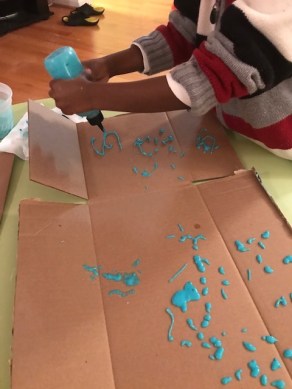
  • Squirt lines, curves, dots, and PICTURES on the cardboard.
My son is having fun with the puffy paint.


My son is narrating and illustrating a story about a Monster playing with friends.

Make this a fun literary activity by doing the following…

  • Paint or draw a picture and create a story about the image.
  • Have the child practice writing their name.
  • Have the child practice writing their letters or numbers.
  • Make a wake up puppet and decorate it with puffy paint.
    • Once the paint dries, read a story using the puppet.

Have Fun Learning and Painting!

OUR KID FRIENDLY FAST & FUN STUDY TRICKS FOR BETTER GRADES: 9 FUN STRATEGIES FOR SUCCESS IN LEARNING AND SCHOOL HAS $29 OFF THE ORIGINAL PRICE.

Our books are available on Amazon, “Teach Your Toddler to Read Through Play,” “Fun Easy Ways to Teach Your Toddler to Write, and “Teach Your Child About Money Through Play.

THE TEACH YOUR TODDLER TO READ THROUGH PLAY ONLINE COURSE HAS A $97 DISCOUNT.

Click here for the PAYMENT PLAN OPTION!

Make Reading Fun for Kids with DIY Book Hook

One day while my three-year-old son played independently with toy cars, I was reading a book that contained over 400 pages. When I reached the end of a chapter, I inserted my bookmark to maintain my place.

My son saw the bookmark and asked me what it was. I told him that bookmarks tell me what section of the book I read previously. It is a timesaver because it prevents me from flipping through the book to find where I stopped reading.

He was amazed that this rectangular-shaped piece of paper could do so much. This was during the time we started reading books like Charlotte’s Web by E.B. White which is a chapter book.

Watch the Video below to Learn How to Accelerate Young Readers’ Skills with Art

We read other books in the past that needed a bookmark like 5-minute Bible Stories retold by Mary Batchelor and Penny Boshoff. This book has a compilation of Bible stories for children. For some reason, we didn’t use a bookmark after reading the book. I just flipped through the pages and tried to remember the last story we read. This was not a good use of time.

Once my son became curious about my bookmark, I decided we should make our own. I am not an artsy person and needed some help in making one that would appeal to him. The book, Easy Art Fun! Do-It-Yourself Crafts for Beginning Readers by Jill Hauser, saved the day.

This book showed us how to make a SIMPLE bookmark or book hook that looks like my son. We had a great time creating them! They are used daily after reading time. My son often tells me we should make more bookmarks.

This a great project to do with the child who won’t sit for an entire book. Try reading part of a book and save your place with their look alike book hook.

So Let’s Get Started with Creating!

How to Make the Book Hooks

Materials:

  • Markers
  • Colored Paper or Card Stock Paper
  • Child Safety Scissors

Method:

  • Help your child draw themselves on colored paper with markers.
    • Draw the arms so that they are hanging low.

Here is the result of his drawing.

Here is my drawing.

I gave him a face, hair, socks, and pants.
  • Color the drawing.
  • Cut out the drawing.
  • Cut the arms with slits

  • Hook your drawing to the top of a page.
  • Close the book and hold your place.


Have more fun with this activity by making a variety of book hooks like…

  • Animals
  • Superheros
  • Letters
  • Numbers
  • Cars
  • Dolls
  • Anything you want

Have fun Creating!

OUR KID FRIENDLY FAST & FUN STUDY TRICKS FOR BETTER GRADES: 9 FUN STRATEGIES FOR SUCCESS IN LEARNING AND SCHOOL HAS $29 OFF THE ORIGINAL PRICE.

Our books are available on Amazon, “Teach Your Toddler to Read Through Play,” “Fun Easy Ways to Teach Your Toddler to Write, and “Teach Your Child About Money Through Play.

THE TEACH YOUR TODDLER TO READ THROUGH PLAY ONLINE COURSE HAS A $97 DISCOUNT.

Click here for the PAYMENT PLAN OPTION!