I am a big proponent of parents interacting and playing with their children. This is the secret of how I taught my son to write at two-years-old.
The method, In-depth learning, is what I used to teach him how to read and write. Before I give you the details, let’s answer some basic questions first.
How do I encourage my child to write?
One good way to encourage your child to write is to make it fun and purposeful for kids. Build a writing activity around your child’s interest. For example, if your child likes cars then have them construct letters in sand or mud with their toy vehicles. You can also create a road with tape in the form of letters. Then have your child follow the path with the cars. If you have a child that likes dolls or stuffed animals, then help them do a role play as a teacher teaching their dolls how to write.
Below are 5 more ways to encourage kids to write…
Get a pen pal for your child to write to frequently.
Help the child write a story about a topic of their choice.
Have the child write with their favorite toy (explained above).
Encourage the child to write with their fingers through finger paint or making letters in sand.
Writing well wishes to family members…
Creating and drawing Birthday, Christmas, or Get Well Cards to Family and Friends.
The book is available on Amazon! Click the image above to access the link.
Not Sure Yet? Then Complete the Form at the Bottom of this Post to Read the First Chapter and Half of the Second Chapter for Free!
How do I teach my child to write his name?
My son learned to write his name at the age of two. He first learned by seeing me write his name repeatedly during long car rides, church services, outside with sidewalk chalk and at the bottom of his art projects. He loved to trace his name with crayons after I wrote it. After seeing it done multiple times, I let him independently write the first letter of his name, then the second letter and so on.
When should a child start writing?
Children first learn to write once they have the strength to hold a crayon and scribble which is around 15 months. According to Zerotothree.org there are five stages of writing. The first stage, at 15 months – 2.5 years old, is when the child is doing random scribbling. Controlled scribbling is the second stage at 2 to 3 years old, when the child makes circles and vertical, curved, and horizontal lines. The third stage is lines and patterns, at 2.5 to 3.5 years old. Drawing pictures of objects or people is the fourth stage. In the fifth stage, children are using letters and numbers to write on their own.
My son’s brain starting processing the concept of writing around 13 months when he repeatedly observed me writing the alphabet and numbers. He was not able to physically write yet, but his brain recorded the loops, lines, and curves I made when I wrote. He wrote his first letter, A, at 21 months.
So, how did you teach your son to write at two-years- old?
There were many forms of playful methods used to teach my son to write. We still use some of the same methods and more to improve this writing skills. Below is what we did.
Play-Doh
Play-Doh is a favorite toy in our household. I used it to mold the alphabet before my son could talk. Constantly observing how letters are formed trained his brain to understand how they are MADE. Once he started talking, he would identify a letter and it was my job to make the letters. He gained a taste of leadership because he had control of what letter I wrote. Eventually, he combined the two skills and was able to identify the letter and shape them simultaneously with Play-Doh.
Form letters with various toys and objects
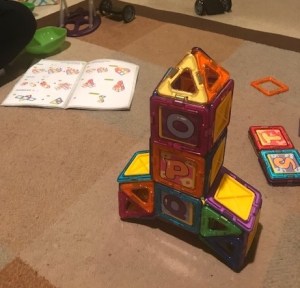
Play-Doh needed its own category because we used it frequently. However, we formed letters and numbers with other toys. We collected rocks and used them to shape letters and numbers in order. Legos and Magnetic Tiles were used to build the alphabet and create silly stories. The numbers we constructed using Gears were created by widgets, connectors and interlocking bases and were accessorized by the colorful gears and crank. We formed letters and numbers with poms and made them disappear by blowing on them.
My son played at a Legos table and created the numbers 1 – 10.
The letter B made from Magnetic Tiles.
Writing in different settings
In order to keep my son’s attention during road trips, church services or appointments, I would write letters and familiar words like his name and favorite animals. I also drew various shapes so eventually he would connect them to the construction of letters and numbers. For example, the letter A is part triangle with a line in the middle and O is an oval.
He observed me writing with various colors on the doodle pad, outside with sidewalk chalk, on the window with window markers, on notebook paper, on craft paper taped to the wall and floor. While I was writing, he would scribble and make abstract art. Then one day, he wrote the letter A!
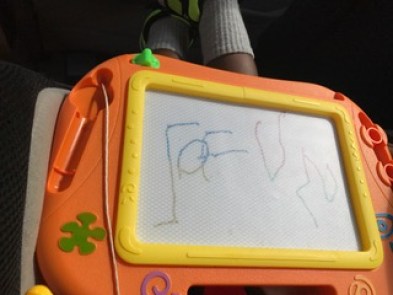
We were driving to an Amusement Park and my son wrote “So Fun” on his Doodle Pad because he was excited!
Observing the alphabet and letters in nature and the outside world
Broken crayons encourages children to pinch it between their thumb and index finger. As a result, he now holds the writing utensil correctly.
Another method is to use the alligator trick. Tell your child to hold their dominant hand like an alligator’s mouth. Have the child open and close the alligator’s mouth like they want to eat something. Then help the child hold the pencil like their hand or alligator mouth is closed on the pencil. The last step is to have your child bend their fingers a bit to grab the pencil.
Put it all together
My son was able to write independently at two-years-old. He loves writing his own thank you notes and birthday cards to family and friends. We are still improving his writing skills through play and fun activities. We have found that opportunities to write are endless and with this fun journey we will continue to move forward.
My son writing a note to his Uncle Linsey saying “I love you.”
One day while my three-year-old son played independently with toy cars, I was reading a book that contained over 400 pages. When I reached the end of a chapter, I inserted my bookmark to maintain my place.
My son saw the bookmark and asked me what it was. I told him that bookmarks tell me what section of the book I read previously. It is a timesaver because it prevents me from flipping through the book to find where I stopped reading.
He was amazed that this rectangular-shaped piece of paper could do so much. This was during the time we started reading books like Charlotte’s Web by E.B. White which is a chapter book.
Watch the Video below to Learn How to Accelerate Young Readers’ Skills with Art
We read other books in the past that needed a bookmark like 5-minute Bible Storiesretold by Mary Batchelor and Penny Boshoff. This book has a compilation of Bible stories for children. For some reason, we didn’t use a bookmark after reading the book. I just flipped through the pages and tried to remember the last story we read. This was not a good use of time.
This book showed us how to make a SIMPLE bookmark or book hook that looks like my son. We had a great time creating them! They are used daily after reading time. My son often tells me we should make more bookmarks.
This a great project to do with the child who won’t sit for an entire book. Try reading part of a book and save your place with their look alike book hook.
So Let’s Get Started with Creating!
How to Make the Book Hooks
Materials:
Markers
Colored Paper or Card Stock Paper
Child Safety Scissors
Method:
Help your child draw themselves on colored paper with markers.
Draw the arms so that they are hanging low.
Here is the result of his drawing.Here is my drawing.I gave him a face, hair, socks, and pants.
Color the drawing.
Cut out the drawing.
Cut the arms with slits
Hook your drawing to the top of a page.
Close the book and hold your place.
Have more fun with this activity by making a variety of book hooks like…
I love projects that inspire kids to be creative and to use their imagination. Art is the number one activity that requires kids to think outside the box and it encourages them to be themselves.
Art is also a great way to make reading fun and appealing to young kids. Children are naturally drawn to art so why not use it to learn other subjects such as reading and literacy? Reading is about interpreting meaning. We love it when kids make something and can interpret their masterpieces to others.
How to use this project to increase your child’s reading skills
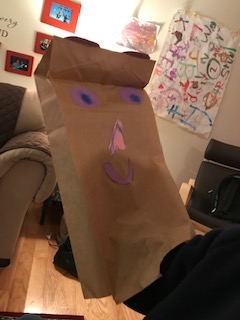
The craft below will provide a fun and educational hands-on experience for kids. It is called The Wake-Up Puppet and can be used while reading a book, pretend play, or whatever else you can imagine. The puppet can be asleep and awake.
My son and I made two puppets and used them while we read numerous books. When it was my turn to read a page, my son’s puppet was sleeping. While my son read, he put his hand in the puppet so it was awake with open eyes.
We also used the puppet in a pretend play scenario with his PJ Masks action figures. Romeo, a villain, put my puppet to sleep with a magic potion. It was my son’s job, as Catboy (a character from PJ Masks), to get my puppet to wake up. He accomplished this by playing his toy drums loudly. We learned the words, snooze and drowsy while doing this activity.
Another way to make this project literacy based is to have your child read the directions while making the puppet. Encourage your child to sound out or say words that they know. If they can’t read yet, help them to use the pictures in this post to show how to make the puppet. Remember, your child will be reading because they are interpreting meaning. Additionally read the instructions to them while following along with your finger so they observe that words are needed in order to make the puppet.
So Let’s Get Started!
Wake-Up Puppet
Materials:
Child Safety Scissors
Colored Paper
Glue
Paper lunch bag
Markers or crayons
Method:
Cut and paste closed-eye almond shapes from colored paper.
Paste the eye shapes on the bag. (View the picture below)
Cut and paste open-eye circular shapes from colored paper.
Paste them under the bag flap.
Cut a heart-shaped or circular nose from the colored paper.
Paste it on the bag.
Cut a C-shaped mouth from the colored paper.
Paste it on the bag.
Decorate the puppet with markers and crayons.
Put your hand inside the bag.
Close your hand for closed eyes.
Open your hand for open eyes.
Remember make this a fun literacy activity by doing the following…
Hold the puppet while you are reading to your child.
Make another puppet so you and your child can hold them while reading to each other.
Do a puppet show about a story you have previously read and change the ending.
Create your own story and make puppets of various characters.
I remember at the age of 17 my older brother, Linsey, gave me the book, Rich Dad Poor Dad by Robert Kiyosaki. This book changed my perspective about how I thought about money.
One point that stuck with me was when you are an adult your report card is your credit score. I found this statement fascinating and I made the decision to do two things after that..
To strive to have an excellent credit score as an adult
To teach my children financial literacy
Check out our new book available on Amazon, Teach Your Child About Money Through Play! It has over 110 Games/Activities, Tips, and Resources. The book is great for kids ages 4-10 and their parents.
Although my son is a preschooler, I have introduced him to money through role plays, having him count and earn real money, and reading books.
I would like all children to be exposed to financial literacy. My contribution is by compiling this list of Children’s Book about Money.
Sign in to our SOY Resource Library and get access to 10 ACTIVITIES TO BOOST KIDS’ FINANCIAL LITERACY KNOWLEDGE.
At five years old, Gabby Goodwin can’t stop losing her hair bows everywhere she goes. She and her mother invent a new kind of bow that doesn’t fall out. Read this book to see if their idea works.
Lily wants a new bike, a new raincoat, and ice cream. But how many of these things does she need? As Lily and her dad drive around town, Lily soon discovers that wants and needs are different things.
Problem-solver Jason Li has been on a mission to pay for his own lunch since he started school. He has an idea that helps him achieve his goal and save the planet.
A lemonade stand in winter? Yes, that’s exactly what Pauline and John-John intend to have, selling lemonade and limeade. Children will learn about simple math concepts in a fun way with this book.
Roxy Ramirez has saved up for weeks to buy a chemistry set, and now she’s headed to the toy store to buy it! There’s only one problem. She keeps running into friends who are in trouble, and need her to dip into her savings to help. Will she have enough money left over to buy something for herself?
Just as a squirrel gathers nuts to prepare for the winter—eating some now and storing some for later—kids can learn the value of money by spending some of their allowance now and saving the rest for later using animals as examples.
This basic introduction to earning and spending explains how people earn incomes in exhange for their work and skill. It then explains the economic choices people make in saving or spending their income.
One little girl and one very big dollar set out on a great adventure at the store. What will she do with so many choices, and only one buck? Read this book to find out.
Let’s Meet Ms. Money is a children’s picture book that teaches children about money. Kids will learn what money looks like, how to count it, how and why we use money, and how we earn it.
Teach your kids the basics about finances with this book. There’s no such thing as too early when it comes to these things. Properly seal the deal about money and other possessions by introducing this book.
At ten years old, Jazz Ellington, has over $2,000 in the bank, and his savings keep growing. His granddad taught him to save his allowance and set up a bank account. This book increases financial awareness while sharing the lives of two African-American boys growing up in the city.
This book teaches discipline, delayed gratification, and how good it feels to give to those in need. Dimes can teach your child the habits that will allow them to have a more financially secure and fulfilling life.
Five-year-old Sebastian Martinez, with the help of his older brother, turns his love for socks into a business that not only makes wacky socks, but also enables the duo to finally revamp the school dress code.
Jeremy wants a pair of the shoes everyone at school is wearing. Jeremy’s grandma says they don’t have room for wants just needs. Read how Jeremy and his grandma navigate through this dilemma.
The 21st Street Sluggers’ shirts are worn-out and dirty. They need new ones, but they have no money. Children will learning to count money and make change.
Arthur starts his own petsitting business to show Mom and Dad that he can be responsible! Between a boa constrictor, an ant farm, and a group of frogs, he’s got his hands full! Can Arthur still prove he is responsible?
Children will get an introduction to American units of money; and how they combine to make a price. They will also learn basic money symbols and the math inherent in shopping.
Children will learn how the dollar is made, the meaning of the symbols that are shown on the front and back of the dollar, and how long the average dollar stays in circulation?
Arthur attempts to earn enough money to buy a t-shirt and cap, assisted by his sister Violet. Children will learn simple business concepts by reading this story.
Dollars & Sense is a basic instruction manual for money that will teach readers about the history of money, the way the American economy works, and how to make important decisions about personal finance.
Papa thinks it’s time to teach Brother and Sister how to budget their money. Children journey with the cubs on their process to understand the value of a dollar.
Rock and Brock are twins and their grandpa offers them a plan―for ten straight weeks on Saturday he will give them each one dollar. But there is a catch! Each buck they save, he’ll match it quick. If they spend it, there’s no extra dough.
This book explains how to create a budget, make money, invest your earnings, and donate to charity. It also teaches kids the difference between needs and wants and getting the most from an allowance.
Ella wants a soccer ball, but she doesn’t have enough money to buy one. She decides to earn her own money. Will she earn enough to buy the ball? Read this book to find out!
Kyle’s club is going camping and all the kids will sell Cool Candy to earn money for the trip. Kyle needs to find buyers for ten boxes of candy. Can he keep track of his cash and join his friends on the camping trip? Read this book to find out!
When Rae witnesses an ice cream and dog mishap, she’s inspired to create a solution to help get dogs clean. Rae draws on her determination and everyone else in her community when she learns what it means to be an entrepreneur.
Children will learn how to not only spend money, but also how to earn it. The quizzes, tips, and helpful quotes from other girls will make learning about money management easy and fun.
This book teaches children the following questions about money: When did we start using it? And why? What does money have to do with writing? And how do taxes and interest work?
When George decides to save up for a red train in the toy store, he doesn’t realize how long it will take or how hard he’ll have to work for his money. Read this book and find out if he gets the train.
Deena has a big problem. Her mom’s birthday is coming, but she has no money to buy a present! Find out how she solves the problem by reading this book.
Find out what happens to your money after you hand it to the cashier. What happens to that money once it leaves your hands? Who actually pockets it or puts it into the bank? Read this book to answer these questions.
Maddy has a piggy bank named Piggy. One morning while feeding Piggy coins for breakfast, Maddy discovers how coins, like people, come in different shapes and sizes.
When Sophie finds fifty dollars on the sidewalk, it gives her a great idea for a new name: Sophie the Zillionaire! In order to keep the name Sophie the Zillionaire, Sophie has to make more money — and fast.
Mama and Papa are worried that Brother and Sister seem to think money grows on trees. The cubs decide to start their very own businesses, from a lemonade stand to a pet-walking service.
Little Critter® wants a new skateboard and Dad tells him that he needs to save his own money to buy it! From feeding the dog to selling lemonade, Little Critter learns the value of a dollar.
This book is about a boy spending the day with Dad coin collecting! He finds out about the value of coins, what people used before coins, and why historical images and people appear on coins.
A young girl sets up a lemonade stand and sells enough cups of refreshment to add up to a dollar. This story combines the teaching of addition with childhood entrepreneurship!
The book explains the concept of money and how saving works based on the concepts of simple and compound interest. Children then learn where Wall Street is located, what stocks and bonds do, and, the right way to buy or sell a stock, mutual fund, or savings bond.
Pete saves his allowance and spends too much of it. He then has second thoughts and starts over. Children will learn how he strategizes over future purchases.
This book will reach kids before bad spending habits can get out of control. With answers and ideas from real kids, this grounded approach to spending and saving will be a welcome change for kids who are inundated by a consumer driven culture.
Follow a class of fifth-graders as they figure out the world of finance, including earning, budgeting, and saving to investing and collecting coins from around the world.
Show Me the Money takes technical terms and breaks it down with easy-to-understand text, diagrams, and illustrations making a formerly dry subject interesting and relevant to kids
Honey Bunny Funny Bunny has a lot of money. She saves some and spends some on herself and friends. This is a rhyming book about spending and saving, told through the eyes of animals.
Mr. Chickee, a blind man in the neighborhood, gives 9-year-old Steven a mysterious bill with 15 zeros on it and the image of a familiar face. Could it be a quadrillion dollar bill? Could it be real? Read this book to find out.
Children will learn how people pay for the things they buy by writing a check, paying with a debit card, paying with a credit card, and paying with cash withdrawn from an ATM.
Provides an introduction to taxes, including some of the products and services that citizens may receive including schools, roads, and national defense.
This book answers the following questions about money: How and where is it printed? What do all those long numbers and special letters on currency mean? How are the newly designed bills improvements over the old ones?How can banks afford to pay interest?
George, a newly minted quarter on his way to the bank, has quite a day. He’s about to be traded, spent, lost, found, donated, dropped into a vending machine, washed in a washing machine, and generally passed all around town.
Fudge is obsessed with money. He’s making his own “Fudge Bucks” and has plans to buy the entire world. However, things get crazy once his family gets involved.
On a summer day, a young girl sets up a lemonade stand and sells enough cups to add up to a dollar. This story combines the teaching of addition with a traditional rite of childhood entrepreneurship!
Saruni is saving coins for a red and blue bicycle. How happy he will be when he can help his mother carry heavy loads to market on his very own bicycle. How disappointed he is to discover that he hasn’t saved nearly enough!
The Nelly Longhair doll is on sale at Murphy’s Toys for ten dollars, but Isabel has only fifty cents. Isabel decides to start a car wash business. Will Isabel earn enough for the Nelly doll?
This is a story of a man who spends his life struggling, saving, and sacrificing to build and own his own barbershop. Although there were many racial difficulties that stood in his way, he opens the doors of his new shop at the age of seventy-nine.
A second grade class wants to visit the Statue of Liberty. They try to earn money for the trip by collecting paper, running a lemonade stand, sitting babies, walking dogs, and selling candy.
Benny McBride starts his day with five new pennies and is determined to spend them all. His family wants him to buy certain items. Will he be able to fulfill their requests?
Have you ever wanted to make a million dollars? Marvelosissimo, the Mathematical Magician, is able to explain how to earn money, invest it, accrue dividends and interest, and watch savings grow.
This book examines the history of money, including the barter system, early trade in North America, unusual types of money such as huge stone disks and salt bars, and the first paper money.
The pigs are very hungry, and there’s no food in the house. Mr. Pig suggests eating out but there is no money! The family goes on a money hunt. Read to see if they find what they are looking for.
Teen lacrosse player Rachel Zietz takes an entrepreneurship course and realizes she can blend the worlds of business and fun by creating a lacrosse equipment company.
Your three-year-old son can read on a third grade level? How?
Just this past weekend, I saw my three-year-old son, Cory, reading a book to his Sunday School teacher and a group of kids. As soon as the teacher saw me, she said “This child can read at three-years-old? How did you do this?” When someone asks me this, my short answer is always by making reading fun, exposure to a variety of books, and playing with words.
Then later that day, I took my son to another child’s home for a birthday party. The kids were having so much fun playing inside and outside. At one point, Cory was playing with the Leapfrog letter set at the refrigerator and spelling words. He asked the birthday boy’s mother, who is a teacher, for the letter T in order to spell the word gift. After spelling, the boy’s mom approached me and said “I can’t believe your son spelled gift!” I replied by saying “Yes, he loves to read and spell!” She said “How did you do this?” Again, I gave her my normal answer.
The book is available on Amazon! Click the image above to access the link.
Not Sure Yet? Then Complete the Form at the Bottom of this Post to Read the First Chapter for Free!
Click the image above to learn more about our ONLINE Course. There is a $97 discount on the online course.
Is your son a genius?
Parents and teachers are usually amazed to know that my son was reading at 21 months. Right now, he can read on a third-grade level. They often say “He is a genius!” I think ALL CHILDREN ARE BORN GENUISES! Cory was born with the same capilibities as every other child. He was just exposed to words and language in a fun way at an early age. In my opinion, any child can do this!
Why did you teach your son to read so early?
It was not my intention to teach Cory to read as a toddler. I didn’t think he would learn the alphabet until the age of three or four. My objective was to expose him to words and language so he wouldn’t be a late communicator. In my experience as a social worker/play therapist, I noticed children who couldn’t speak would resort to hitting or kicking out of frustration. However, once they developed language this behavior would decrease because they could communicate their needs and wants.
As I started exposing Cory to words through play and reading, I noticed that he liked what I was doing. After reading a book to him as a baby, he would take the book and give it back to me. He wanted me to read it again. I remember my husband read the book, Brown Bear Brown Bear What Do You See ten times in a row to Cory at one time. He enjoyed the interactive activities and games we played, which I used to exposed him to new words daily. He has always loved playing with letters, learning the phonics, and blending sounds. Finally, there came a point were he had a desire to seek meaning from words through reading!
Watch my three-year-old son read the book, Charlotte’s Web. A book for children ages 8 and up.
Why is reading a struggle for some kids?
Reading is boring.
Some kids think reading is boring. Many young children spend their days playing. Then once the child turns five or six-years-old, adults tell the child that they have to sit down, focus, and learn to read. Learning to read can be a frustrating process for some kids. It takes time and concentration because one of the best ways to become a better reader is to read. This can be difficult for the child who is a kinesthetic learner, as most kids are, and loves to be physical and experience what they are learning.
My Child is not trying hard enough
Sometimes when a child is behind on their appropriate reading level, the teacher will tell the parents. Parents usually get nervous and upset by this information, and these emotions transfer to the child. During home reading sessions, the parents get frustrated with the child because “they are not trying hard enough.” This most often leads kids to having a negative view of reading. They will often tell their parents “I hate reading!” In turn the parents become more upset because their child is behind their classmates and they are unable to motivate the child to read.
Parents don’t know where to start
Teaching a child to read can be an overwhelming task. First, you have to learn the alphabet, phonics, blending sounds, sight words, and the various rules of the English language. Parents may have a child that knows the alphabet and phonics but is having difficulty with teaching them sight words. Flashcards are often used to teach sight words, but again the child thinks this is SO BORING!
Furthermore, if a child is reading a book with a lot of words they are unfamiliar with, they may get irritated and want to do something else. Additionally, how do you explain that the word bat can be an animal and a tool used for baseball? Oh and when you see the letters PH together, you should make the F sound. Also, C can make the short sound like in cat or the long sound like in cell.
My Child won’t sit during reading time.
I have heard many parents complain that their child doesn’t want to sit and read an entire book. As parents are reading, the child may look in space and not pay attention. Or if the child can read, they get distracted by something happening in the background. Sometimes a parent may read the first few pages of a book to a child but the story line is boring which causes their mind to wonder.
My Child is uninterested in reading about the topic.
A big reason why some kids don’t like to read is because they are uninterested in the topic. This often happens when kids have to read school textbooks or remember facts that they have no connection to. The kids are wondering why they have to know this information. Parents and teachers are trying to get their children to retain the information and it is just not happening for the child. This can be a pretty difficult situation to navigate.
Below are questions many parents have about reading…
What age should a child learn to read?
Most kids start learning to read at 6 or 7. Some kids start earlier at the age of 4 or 5. I believe children have the ability to recognize words earlier. My son started recognizing words at nine months.
One day my son and I were playing in the basement. I asked him to get the book, Brown Bear Brown Bear out of the bin. Out of the 12 books in the bin, he picked the correct title.
My son was able to blend sounds to make words at 21 months. The only reason he did this so early was because he was exposed to it as a baby. However, all children learn at different times and levels. They also learn with various methods. It is important to concentrate on your child’s level and their readiness to learn.
Watch the video below to see my son spelling at 21 months old
How can I help my child learn to read?
There are countless ways to teach kids to read. Kids learn through reading, talking with others, story-telling, workbooks, digital media and technology, learning phonics and sight words, blending sounds, writing, and asking questions.
Let’s say you want your child to learn about other countries, then observe your child and see what they like and offer a connection. For the child who loves sports, have them read about Sports played in the countries. If your daughter loves princesses, have them read about princesses around the world.
How long should a child read each day?
Children should read at least 20 minutes a day. However, if a parent is doing formal reading lessons then all you need is 15 minutes a day. Outside of the 15 minutes, please know that reading can take place anywhere. Children can read a dinner menu, playground signs, grocery list, captions on their favorite cartoon.
How do I help my child who is struggling with reading?
First, you must define what struggling means. If you are comparing your child with other kids in the classroom or the national standards of reading and they are below their level, then yes they maybe struggling. However, if you don’t compare them to anyone, you may realize that they just need more time to get the concept.
When a child needs more time with reading, ensure you are teaching to their learning styles.
Auditory learners love to learn through hearing. Great activities for them would be to read books based on songs and retelling stories you have read and adding music with DIY instruments like banging the bottom of an oatmeal container. Visual learners use sight to learn. They would enjoy drawing and painting colorful stories and doing word puzzles and games with colorful pictures. Kinesthetic learners love explore the world through touch and movement. Try building model sets based on books and doing a Treasure Word Hunt Gamewould be fun for them.
In my opinion, the best way for children to learn to read is through playful in-depth and natural wholesome interaction. It is the best way to create a desire in children to read.
This is why I have written the ebook, Teach Your Toddler to Read Through Play: A Detailed Account With Over 130 Games/Activities, Tips, and Resources.
My goal is to help you expose your child to words and reading in a fun way. This book will take you through a step by step process of how I taught my son to read. It gives you games/activities to do with your child along the way to make reading a process that is fun, natural, and interesting! It will help spark your child’s curiosity in wanting to seek meaning from words which is essentially reading.
This book provides the following…
A detailed account of how I taught my son to read
Over 130 Reading Games/Activities and Resources
How to expose your child to new words through play
The types of books to start your child’s reading journey
How to encourage curiosity in your child
Child brain development and how to develop faster connections in your baby’s brain
How to expose newborn and babies to words through play and bonding
How my son was able to recognize words as a baby
How to make rereading books fun for you and your child
Simple ways to create a literacy rich home
The MOST important thing you can do as a parent to encourage reading in your household
How songs and dancing assisted in teaching my son to read.
How to take full advantage of the FREE Services at your Local library
How Physical Activities can boost your child’s reading skills
How to Teach the Alphabet in a Fun Way
How to Teach the Phonics, Blending Sounds, and Sight Words in a Fun Way
The three basic learning styles in children
How to determine your child’s learning style
How to expose children to new concepts aligned with their learning style
How children with certain learning styles tend to communicate
The toys/activities children with certain learning styles tend to favor
How to make learning fun and playful for children
How to determine the best time to teach your child
How to execute Fun In-Depth Learning
How to use the body’s senses to teach your child
How to combine In-depth learning and learning styles during play
How to incorporate digital media in your child’s learning
How to teach a child with more than one learning style
How to Structure your Day
How to progress to teaching your child the phonics
How Writing and Art can build a child’s reading skills
How to Use Real World Experiences and Field Trips to expose children to language.
How to Choose Books your Child will Like to Read.
Strategies for When your Child Loses Interest in Reading.
Examples of toys we used
Examples of books we read through our journey
Once your child begins to read, how to continue to build their skills.
Here is What Others are Saying About the Book
“This was a wonderfully detailed account of not only how to teach your child to read, but also how to connect with your child, support your child in a lifetime of loving to learn, and use your time caring for your child in a meaningful, fulfilling way. I am inspired as a mother, and I wish I’d known about this sooner!
I thought it was very well written, and the flow was perfect. The book flowed seamlessly from one chapter to the next, and I felt like it was organized perfectly.”
-Stacey
“This is a wonderful guidebook for parents who want to help their children begin learning at an early age through play. It is an introduction on how to nurture a love of learning and proficiency in reading in children, which in turn will open the door for your child to be exposed to and learn about a variety of topics. Andrea incorporates several learning styles in order to pave the way for a lifetime of learning.
I look forward to incorporating some of these techniques into playtime with my little learners.”
-Danielle J.
“This book documents the journey of an engaged parent who used creative and fun ways to introduce her son to books. This led to the child’s continuous interest in letters, words, sentences and naturally, reading. If you are willing to invest the time in incorporating the tips in this book with your child, he or she will also develop an interest in books and learn to read during the early stages of brain development. This book is an excellent example of the African Proverb “Each One Teach One.”
-Linsey Mills
This is a great e-book for parents with children ages 0-7! Invest in your child’s future. Reading is the most powerful tool to promote creativity, increase brain power, and it helps your child express themselves better! The best way to teach a child to spell and grammar rules is not through flashcards and worksheets but through reading and play!
Not Sure Yet? Then Complete the Form at the Bottom of this Post to Read the First Chapter for Free!
The book is available on Amazon! Click the image above to access the link.
One day a group of moms and I were sharing information about our hobbies, jobs, and businesses. I told the group that I just started a YouTube Channel with Fun Accelerated Learning Tips for Kids. One mom asked me to make a video of Study Tips for Tweens/Teens. Excitement was my feeling because I love doing research, telling others what I have learned, and solving problems. My response was “I will work on it!”
Below is what I have experienced and found to be effective study habits and strategies for kids.
Let’s Get Going!
Want More Tips? Get 3 Tools Every Household Needs to Boost Children’s Academic Success.
How Can I Help my Kid study?
Create conversations
You can assist your child with their school work by being involved in their studies. Ask your child about the topics they are learning about in school. Create conversations during dinner, car trips, or walking the dog about that topic and share what you know. If you don’t know much about the topic, have your kid teach you about the subject. You may also do your own research on the topic and share what you learned.
Being Involved
Another way to assist your child is to attend parent conferences, open houses, or back-to-school nights. Students usually do better when they are supported in their academic life. As a parent, request meetings with teachers and other staff just to check your child’s progress. These meetings should happen whether your child is doing well or need some extra attention with school work. Open Houses or Back-to-School nights are when parents learn about school programs and polices and other opportunities your child may take advantage of.
Children should have a conducive studying environment. This includes having the tempature between 74º and 77º. It is helpful to place desks or tables away from distractions. Some parents find putting their child’s desk in the corner of their room away from the door and facing the wall helpful. Natural light is the best light to study with; however, if this is not available, ensure there is proper lighting in your child’s study area.
Another tip is to have a distraction sheet near your child in case they have ideas pop in their head that are not related to school work. The child can write down their thoughts to prevent them from constantly thinking about it during study time.
What are the habits of Successful Students?
Learning Outside the Classroom
Two habits of successful students are learning outside the classroom and doing practice exams. Many successful students don’t just read the text book provided by their school, they take the initative to learn about a topic through reading other books, watching educational videos, and through experience. For example, if a child is learning about the American Civil Rights Movement, they may read about civil rights leader Congressman John Lewis, watch a documentary on the movement such as Eyes on the Prize, or visit a history museum.
Practice Exams
Successful students often do practice exams. A practice exam can be informal when a parent is having an analytical dialogue or asking the child questions about the topic. It can also be formal where the parents create a practice test for their child. Practice tests can also be found in the back of other textbooks on the subject. Sometimes, you can find older editions of textbooks at your local library.
Let’s say your child is taking geography, then observe your child and see what they like and offer a connection. For the child who loves sports, have them research Sports played in the countries they are studying. If your daughter loves fashion, have them research the dress and fashion trends in the countries they are studying. Take it a step further and compare their findings to what happens in their home country.
Another way to spark interest in studies is to encourage the child to find how it applies to their lives. Another subject I did not like in High School was Physics. However, if I would have done some hands on physics experiments then I would have been more engaged in my studies. For example, a great physics lesson is visiting a playground and studying how the two opposing forces of a seesaw lever and fulcrum (placed in the middle) counterbalance each other, creating a smooth ride through the air. My only exposure in high school to physics was in a book and I did not connect with it.
4 Ways to Improve Study Habits
Chunking information
Chunking is the process of breaking information into smaller pieces so the brain can digest it more easily. As a second grader writing a short story in class, I could not remember how to spell the word together. I got up and asked my teacher and she said three words “to” “get” “her.” From that time on, together has never been a word I have forgotten to spell.
Chunking can be done in many ways. Kids can group together information by categories. For example, if your child is learning the symbols of the periodic table, they can remember them by groups. First they may learn the Group 1 which are the alkali metals, then move on the Group 2, the alkaline earth metals, and so on.
Mind mapping
Mind mapping is one of my favorite ways to learn new things. It is an easy way to get information in and out of your brain. With mind maps you can study, take notes, create new ideas and plan projects. It consists of words, colors, lines, and pictures, which coincides with how our brain thinks.
There are 5 steps to Mind Mapping.
Get a blank paper with colored pens, pencils, markers, or crayons.
Draw a picture in the middle of the page that sums up your topic or subject.
Draw thick curved, connected lines coming away from the picture, one of each for the main ideas you have about the topic.
Name each of these ideas and it is helpful to draw pictures of each.
For each of the ideas, draw other connected lines spreading like tree branches.
These represent the details.
We remember information better with pictures because it uses both sides of the brain. For example, it is natural for photographs, books and magazines to bring back our memories. If you want to remember all your favorite things, just draw a color coded picture like below.
If you wanted to Mind Map an article, use the basic elements below in your picture.
What?
Where?
When?
Who?
Why?
Conclusion
Creativity
Get creative with how new information is studied especially if it is a subject you are not fond of. If you love making home videos, create a show on the information you are studying and perform it for family and friends. Another idea is to make up questions about the subject and play a trivia game with friends in your class. Have all your friends bring a certain amount of questions for the game. If you like music, write a song about the information and put it to a catchy beat.
Please note: As you are preparing for your creative way of studying, ensure you understand the material first to pinpoint any area of confusion you have.
Get creative with how to study information
Create a You Tube video teaching others about the topic.
Create a commercial or role play on the information.
Schedule but with a Catch
It is helpful to set up a daily schedule of when you will study. However, it is important to include fun things like hobbies, time with friends or playing video games, and digital media time. You are more likely to complete tasks when you have playtime and work time on your schedule. This allows you to create in your mind something to look forward to.
Association
One of the easiest ways to remember information is to associate it with something in which you are familiar. For example, make up a sentence using the letters in the formula to remember the area of a rectangle which is A = lw. The sentence could be Laura and Will had a big baby named Adam. Try to use items that you will remember like name of friends and family.
I hope you have found these tips helpful!!!
Use these studying strategies above to make studying revelent, interesting, and fun!
Did you know that children show signs of reading as infants? Reading is all about discovering meaning and this is what your baby did when they first responded to your smile.
Sometimes discovering meaning can be lost with traditional ISOLATED learning methods such letter sounds and worksheets. Reading should follow the natural way that children learn which is through a variety of experiences and following their interests.
Following Your Child’s Interest
If children are offered reading material that follow their interests, then they will want to seek meaning from words. From this desire, they will learn word recognition and phonics skills.
Children learn best from discoveries they make from exploring the world around them. They gather conclusions from their experimentations and creative play. For example, in water play, they learn about volume, capacity, and the properties of water as they pour it cup to cup.
What You Can Do As a Parent
Your job as the parent is to describe their play and provide them with language. During water play, use descriptive words such as wet, splash, ripples, warm, and cool. Then expose them to similar words by reading books dealing with water such Splish, Splash Ducky by Lucy Cousins or Spot Goes to the Swimming Pool by Eric Hill. This is the beginnings of you making connections with language and play.
The games/activities provided below will help you make more connections with words through creative play.
Children should be provided opportunities to apply knowledge from books through imaginative play. Below is a way to stimulate your child’s ability to problem solve, sort information, and develop new ideas through creative-thinking questions. Below is how to do it…
Read a story to your child.
Ensure your child is familiar with the story.
You may have to read the story multiple times to your child.
Have your child change the ending.
They may communicate their version of the ending through the following…
Drawing a picture
Creating a sculpture with Playdoh or Clay
Creating a dance
Role playing with props
Simply telling the story
Clues from the Story
The following activity will develop your child’s listening skills. It is also great for reading comprehension and learning new vocabulary.
Read a story to your child.
Ensure your child is familiar with the story.
You may have to read the story multiple times to your child.
Gather clues from the story you have read. Clues from the story can include…
Characters
Setting – where the story took place.
The conflict or problem in the story.
The story’s resolution
Basically anything in the story
Let your child guess what you are thinking from the story with the clues you give them.
Use descriptive words to describe your clue such as…
“I’m thinking of a humongous animal with a large trunk.”
Then let your child give you the answer which is elephant.
Now let your child think of something and give you clues.
Another variation of this game is to have your child get clues by asking you yes/no questions about a mystery item.
“Is it large?
“Does it make a loud noise”
Treasure Hunt
This game is great for reading comprehension. It also helps your child learn how print and pictures carry meaning.
Read a story to your child.
Ensure your child is familiar with the story.
You may have to read the story multiple times to your child.
Tell your child they are going to do a treasure hunt.
Find one vocabulary word, item, or character from the story.
If you have the item in your home, you may use it for the hunt.
If you don’t have the item, you may draw a picture and briefly describe it on separate piece of paper.
Hide the item in your home.
Leave a series of notes or pictures to help your child find the item.
For example, write “Go to the dining room table” or draw a picture of the dining room table.
On the dining room table, have another note ready stating, “Go to your bedroom” or draw the child’s bedroom.
Your child will continue finding and following instructions on notes or drawings until he/she locates the item from the story.
Once your child has found the item, ask them to identify the item and how it fits in the story.
Charades
You will need more than one child for this game. This game is great for reading comprehension and promotes in-depth learning. In-depth learning is when you learn about something in various ways. Charades will allow your child to learn words through physical activities, reading, and application (identifying where it fits in the story)
Read a story to your child.
Ensure your child is familiar with the story.
You may have to read it multiple times to your child.
Write vocabulary words or characters from the story on index cards or paper.
Players will take turns picking these cards from a plastic bag and acting them out.
The other players will guess the word.
Once the word is identified, then have the child identify where the word fits in the story.
Another variation of this game is to have the player draw a picture of the word while the other players guess the word.
Spy a Word
Read a story to your child.
Ensure your child is familiar with the story.
You may have to read it multiple times to your child.
Omit a word and let your child fill in the blanks.
Let’s say you read a story where a mouse is trying to find cheese.
You say “In the story, the mouse is trying to find……
Let your child say “cheese.”
Keep stating the plot of the story and let your child fill in the blanks.
Another variation of this game is to fill in the blanks with silly words and let your child correct you.
You state “In the story, the mouse is trying to find a cat to eat him.
Let your child correct you with the word “cheese.”
*THIS POST CONTAINS AFFILIATE LINKS, WHICH MEANS I RECEIVE A SMALL COMMISSION, AT NO EXTRA COST TO YOU, IF YOU MAKE A PURCHASE USING THE LINKS.
I love toys where children can use their imagination to build and create various objects. These types of toys exercise children’s brains by teaching early math skills and spatial awareness.
Below are imaginative toys that my son loves!
These toys occupy his time, provide fun educational opportunities, and bring out his inner engineering skills.
Let’s get started!
1. Magnetic Tiles
This is such a versatile STEM toy. My son has built letters, numbers, rocket ships, ferris wheels, towers, and cars with this toy. It has an instruction book to teach you how to build various objects. It is a great way for kids to use their creativity and engineering skills!
We built a rocket ship!This is the letter B!
2. Learning Resources Gears
Gears are a great STEM toy that encourages kids to sort, group, count, construct, design and solve problems. My son has built homes and traps for his action figures with this toy. He also likes to build letters and numbers with the gears and widgets.
This is the letter T!This is the letter P!
3. Legos DUPLO Town Truck & Tracked Excavator
This is a great toy for children who love cars, trucks, and construction vehicles. Whenever we pass by a construction site, my son can name all the vehicles because of the books we have read and hands-on learning provided with these Legos. We have also created stories around the characters and vehicles to incorporate literacy. The package says it’s for children ages 2-5 but my 7-year-old cousin played with these and had a great time!
Multiples of 3 Lego City!
4. Sum Blox
This amazing toy taught my son how to add numbers 1-10. The “height of each number corresponds to its value.” For example, the “1-block” is the shortest number and the “10-block” is the tallest number. If you stack the 5-block on top of another 5-block, then they will equal the same height as the 10-block. Your child will learn that 5+5=10 by building creative structures such as walls, towers, bridges, etc. These blocks are a bit pricy but worth it, in my opinion.
5+5=10He created a tower for his cars to go through!
5. Wikki Stix
My son and I love this simple yet fun toy. It keeps his attention through church services and in waiting rooms. Wikki Stix allows your child to create any object they want. They come in fun colors and require no mess. Boredom is NOT an issue when it comes to this toy.
Making a footballAll done!
6. Flexi Rods
This is not exactly a toy but a hair product. I had unused flexi rods in my closet and gave them to my son to play. He played with these for 45 minutes! These rods twist and turn in to various shapes and objects. My son likes to create letters and numbers with them. My pediatrician said it strengthens his hands and is a great fidgeting toy.
He built these letters and put them on my computer.
7. Automoblox
I discovered these during a playdate. Your child can take these cars apart and rebuild them. It teaches kids to problem solve, color recognition, and coordination. When my son and I are racing the cars, sometimes I will take one apart and pretend he is a mechanic. His job is to rebuild the car so we can race again. He loves this game!
Building the car!Put the car together with success!
8. Steam Dinosaur Toys
This is a great toy for kids who like dinosaurs. Children can take the dinosaurs apart and rebuild them using kid-sized screwdrivers. It develops hand-eye coordination, puzzle solving skills, and patience. The dinosaurs have wheels on the bottom so you can slide them on the floor and race them.
Triceratops is being taken apart.A race is about to happen between two dinosaurs!
9. Snap Circuits Jr.
This toy is recommended for children ages 8 and up; however, my three-year-son and I love building with it. This kit allows you and your child to build working models of a photo sensor, flashing light, and adjustable-volume sirens. Your child should have a basic knowledge of letters, numbers, and putting together puzzles in order to maneuver this toy. Parental supervision is needed if your child is under 8. I advise you to learn how the circuits work then present it to your child.
Starting to build an electric light and switch.Success!He just built the flying saucer!
10. Bristol Blocks
My son received this toy for his birthday. He has built cars, airplanes, robots, letters and more with these blocks. They have built his hand strength and eye coordination. He has learned how various geometrical shapes can be connected to make a masterpiece. Our favorite activity is to build something and make up a story around what was created.
He likes building letters! Here is letter E!
Please tell us which toy your children like! All of these are a hit in our household!
*This post contains affiliate links, which means I receive a small commission, at no extra cost to you, if you make a purchase using the links.
It is a great time to do fun and thoughtful holiday activities with kids! I love this season because it is so full of life, joy, and love! It is also a time to celebrate the birth of Christ, spend time with family, and to give thanks for our presence here on earth. What I love most of all about the holidays is GIVING to others!!
Yes, the act of giving makes others feel good but it benefits the giver as well. It boosts “neurochemical drivers of happiness” and helps to normalize levels of serotonin which promotes feelings of comfort and well-being. I wanted my son to give and experience these feelings.
Therefore, we have done the following activities below to share and receive the pleasant feelings of holiday giving!
Paint Rocks and Give as Gifts
Last Christmas, when my son was two years old, I encouraged him to give gifts to family members. We chose to find big rocks in nature and paint them. We packaged them in colorful wrapping paper and gave them away.
My son was so excited that he could give gifts! He asked me 5 consecutive days before Christmas if it was time to give the rocks away. His rocks from last year are currently displayed in my family’s homes and he is proud. This is a simple yet fun project.
Pour soap and water in plastic container to make soapy water.
Clean rocks with soapy water and toothbrush.
Empty soapy water and put clear water in container to rinse rocks.
You can also run water over rocks to rinse them.
Pour water in cup for cleaning paint brushes of previous color.
Put napkins in paper plate #1 to dry paint brushes.
Pour small sections of various color paints on paper plate # 2.
Place rock on table with newspaper or magazine paper.
Let your child be creative and paint the rock.
Washing rocks in soapy water! Rinsing the rocks in water! Setting up our supplies! He likes mixing the paint. Finished product!
Count Money and Buy a Gift
When I was young, it was my job to take my parents’ loose coins and put them in a money jar. Every year, about three weeks before Christmas, I would put the pennies in wrappers. Afterwards, we took a trip to the bank to exchange the coins for dollars. I took this money and bought gifts for my mom, dad, and older brother.
There are so many lessons learned within this activity such as: counting, money recognition, sorting and the purpose of banks. Another skill I learned was awareness of others. A child may buy his dad green socks because it is his favorite color or mom a cup because she loves drinking tea in the morning.
Brainstorm with child what family members or friends they will purchase gifts for.
Have the child list the person’s interest and favorites.
Make a tentative list of gifts for each member or friend.
Your list may change once you go shopping.
Go shopping.
Help the child the wrap gifts.
Watch their faces light up when family members or friends open their gift!
Inputting Coin Wrapper in Nadex Coin and Wrap Set. Inserting the coins Coin Wrapping is complete!
Check out our new book available on Amazon, Teach Your Child About Money Through Play! It has over 110 Games/Activities, Tips, and Resources. The book is great for kids ages 4-10 and their parents.
Please note that you can make other items such as hearts and rainbows.
This is a simple project to make with kids. There are two cars in the kit. Kids will enjoy the experience of decorating their cars with colorful stickers. This activity also helps with spatial awareness, creativity, and focusing. This would be a great gift for children to give to family members.
Follow directions in the Kit for the best results.
Just getting started
One car is complete and another left to go!
Create Your Own Christmas Cards Artwork
Instead of buying birthday cards for family members and friends, my son likes to make his own. The personal touch of a handmade card from a child is priceless. The time and effort it takes to create a masterpiece for a loved one fills their soul with joy. The person knows the child took time to make something especially for them. So why not have this same experience during the Holidays?
My son has started to make his Holiday cards already. It is a symbol of appreciation for the person’s role in his life. Your child can create their own masterpiece and present it to family and friends. They can use crayons, stickers, markers, glitter and whatever their minds come up with to decorate this card!
Creating a Masterpiece on the Holiday Card. Finished Product!
Complete the Form Below to Download Holiday Card!
Below are details about the card…
Downloadable 5 x 7in postcard
Child can create artwork in the white rectangular space
Ability to type in white rectangular space with computer
*This post contains affiliate links, which means I receive a small commission, at no extra cost to you, if you make a purchase using the links.
Every fall, I ask myself what are simple, fun, and educational pumpkin activities to do with my son. We attend fall festivals in our county and get at least 4 pumpkins annually. This year, I was looking for activities that DID NOT require me to purchase more craft supplies from the store. I wanted to use items that we had on hand.
Get the password for the library with Creamy Pumpkin Soup with Rice Recipe by completing this form. Once you press the GET ACCESS NOW button, we will send you an email with the password. Then go to SOY Resource Library and enter the password.






 Have Fun Reading and Playing!