6+ Fun Activities to Teach Kids Shapes

Did you know that when your child is learning about shapes they are being introduced to geometry? Shapes are not only important to math but generally in life. A child who can identify shapes will learn how letters and numbers are formed.

This prepares them to have better handwriting skills.

For instance, the letter O is basically a circle. Also, shapes can be combined to make various pictures. For example, typically when a child draws a dog they include a horizontal oval for the body, rectangular shapes for the legs and tail, triangles for the ears, and circles for the nose and eyes. 

The knowledge of shapes is useful for building, which is an introduction to engineering. My son learned so much about what shapes to use when building certain structures with his magnetic tiles. He learned that rectangles and squares make great bases or foundations for structures. Additionally, he noticed that hexagons resemble circles.

The houses he often creates are made of a cubes and triangular prisms. Furthermore, his towers are made with a combination of hexagons, squares, and triangles. As a result, he is able to use his knowledge of building basic structures to make more sophisticated towers.

My son knew the basic shapes as a one-year-old. If I called out a shape, he was able to point them out in books or choose the correct one and give it to me. This was mainly done through playing with shapes and reading various books on shapes.

Let’s talk about various ways to make learning about shapes fun.

Below are 6+ Fun Activities to Teach Kids Shapes

Create Your Own Shapes

  • Take Q-Tips, put glue on it, and form them into shapes on paper. Pour glitter on the Q-tip to decorate the shape.
  • Let your child take food such as grapes or crackers and form them into shapes during snack time. 
  • Build shapes with Legos, Magnetic tiles, sticks from outside or anything your mind can think of.
My son made a combination of triangles with grapes and toothpicks.

Make Shapes Disappear

  • Go outside and make shapes with sidewalk chalk
  • Call out a certain shape to your child
  • Give your child a spray bottle with water, a cup of water, or water hose.
  • Have your child pour or spray the water on the shape you identify to make it disappear.

Digital Media

My son and I love watching educational videos. Many times, after dinner, we dance, sing songs, or just watch videos about shapes on YouTube. Below are some YouTube videos about shapes.

*Please note that digital media should not be the only way your child learns the shapes. It should be a way to supplement what you have previously introduced to your child. In other words, expose your child to shapes first and then use digital media.

Play the Shape Game

  • Draw one shape on paper like a circle
  • Then give your child the paper 
  • Ask your child to create a picture from the shape.
  • They can create a cat, monster, or anything they want 
  • Next, have your child draw  shapes
  • Then you create a picture from the shape they just draw
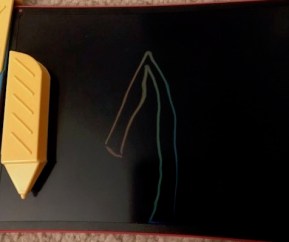
My son drew the shape of number one.
I turned it into a horse with a combination of triangles, rectangles, and lines.

Read Multiple Children’s Book about Shapes

My son and I have read many books about shapes before nap and bed time. These books were colorful and included relatable characterers that my son liked. There were some that did not have characters but presented shapes in an engaging manner. Below are a list of seven children’s book about shapes.

Purchase Toys that Encourage Kids to Learn Shapes

  • Geoboard – stretch the rubber band over the pegs to make various shapes. 
  • Tangram – use the seven shapes to create an image you want.
  • Shape Puzzles – create role plays with the shapes puzzle pieces as characters.

Have Fun With This Activity!

OUR KID FRIENDLY FAST & FUN STUDY TRICKS FOR BETTER GRADES: 9 FUN STRATEGIES FOR SUCCESS IN LEARNING AND SCHOOL HAS $29 OFF THE ORIGINAL PRICE.

Our books are available on Amazon, “Teach Your Toddler to Read Through Play,” “Fun Easy Ways to Teach Your Toddler to Write, and “Teach Your Child About Money Through Play.

THE TEACH YOUR TODDLER TO READ THROUGH PLAY ONLINE COURSE HAS A $97 DISCOUNT.

Click here for the PAYMENT PLAN OPTION!

Giant Bubbles for Kids

One day I got an email from Kiwico.com about DIY science experiments. I saw directions on how to make giant bubbles. I could not wait to show my son, Cory, the bubble activity. Once he saw it, he was excited to get started.

We had all the materials in our home except one item, push pins. We immediately went to the store and purchased the push pins and started to build the wand for the giant bubbles.

If you do this activity once with your child, it will not be your last. So far, we have done the activity three times. The first time, Cory was excited at how big the bubbles were. However, we wanted them to be bigger. So like scientists, we tested and adjusted our approach. The second time was even better than the first.

So let’s get started with how to do this fun activity.

Below is a video of how it is done. This video comes from my son’s YouTube Channel, Corban’s Fun Learning Adventures. Please like and subscribe for weekly fun learning activities. There are also written directions below for Giant Bubbles.

Materials:

Directions:

  • Gather materials to make the giant bubble wand and bubble solution.
  • Start creating the giant bubble wand by sticking a pushpin into the end of each dowel. Don’t push it in all the way but keep the pin about a 1/8-inch from the dowel.
We put the pushpin in about 1/8 inch from the dowel.

  • Cut a piece of yarn about 4 feet long.
  • Tie one end of the yarn to the exposed metal part of the push pin.
  • Push the pin into the dowel to hold the knot
  • Thread the yarn through the washer.
  • Tie the other end of the yarn around the push pin on the second dowel.
  • Push the pin in to hold the knot.
  • Cut a shorter piece of yarn that’s about 18 inches long.
  • Tie the ends to the longer yarn a few inches away from the dowels.
  • This should create a triangular shape.
  • Now it is time to make the bubble solution.
  • Mix 1 part dish soap, 4 parts warm water, add a teaspoon of glycerin, and stir well.
  • Using the dowels, dunk the yarn and washer into the solution.
  • Lift up the dowel and hold it out so the triangular shape opens up.
  • Walk the dowel around to see the giant bubble take form.

  • We liked these bubbles but wanted them bigger.
  • Therefore, we made some adjustments.
  • We made the yarn longer by cutting it 6 feet instead of 4 feet.
  • My husband provided us with a bigger and heavier washer.
  • The shorter piece of yarn was cut to 30 inches instead of 18 inches.
  • We used Gazillion Bubbles because we did not have time to make our own bubble solution.
  • We also learned that bigger bubbles will pop MORE often in hot and dry weather. This weather makes the water in the bubble evaporate too quickly which causes the bubbles to pop.
  • In the picture below, it was cloudy and rainy outside.
  • The result was we made bigger and better bubbles.

Try this activity and have fun!

Don’t forget to check our two books, Teach your Toddler to Read Through Play and Fun and Easy Ways to Teach your Toddler to Write.

Fun and Easy Ways to Teach Your Child to Write

Many parents ask me how my son started writing at such a young age. He wrote his first letter A at 21 months. He could also write the alphabet and numbers 1-100 at the age of 2.5.

My son writing numbers 1-100 outside at 2.5 years old.
Here’s a video of my son, age 2 at the time, writing the alphabet outside.

Teaching a child to write can be a difficult task, especially if the child does not have a desire to learn. Below I will answer the most frequently asked questions when it comes to handwriting skills and children. You will find creative and enjoyable teaching techniques in my new book, Fun and Easy Ways to Teach Your Toddler to Write.

It has over 135 activities, resources and tips for teaching writing with PLAY.

The Book is Available on Amazon in Paperback and Kindle! Click on the Image Below to Find It.

GO TO THE BOTTOM OF THIS POST TO GET THE FIRST CHAPTER AND HALF OF THE SECOND CHAPTER FOR FREE.

Let’s Get Started!

How Can I Help with Writing?

Part of learning to write involves remembering how letters, shapes, and numbers are formed. Most children are taught this through tracing letters, numbers, lines, and shapes repeatedly. Although this is very effective, there are other scientific-proven tricks that can accelerate the learning process and make it fun.

One Fun Scientific Trick to Use When Teaching Your Child to Write

One scientific trick I have used is called Picturing Information. I read about this method in the book, Learning How to Learn: How to Succeed in School Without Spending All Your Time Studying; A Guide for Teens and Kids. Picturing Information makes it much easier to remember. This involves using both the right and left brain strengths into learning. One way to do this is to convert a fact into a picture, so you can remember it more easily. If the picture is strange or unusual, it is easier to remember. Additionally, if the picture involves movement, then it makes the connection stronger.

Let’s use a letter as an example. If your child is learning to write the letter A, you may want to connect it with a picture of a triangle. While tracing or showing them how to write it, tell your child the A is part triangle with a line in the middle. It is important to use what is familiar to your child for the picture. In other words, ensure the child knows what a triangle and line look like. If they don’t know, then use another picture such as stick man legs with a line in the middle.

You may also describe an A as stick man legs with a line in the middle.

When should a child be able to write?

Most experts say that children learn to write between the ages of 3-6. I believe children learn to write before they actually start writing if exposed in the right way. This begins once a parent exposes their child to how letters, numbers, and shapes are formed through reading books, building, doing art, and participating in physical play. When children see letters, shapes, and numbers in books or in the real world often, their brain is taking note of how they are formed. When children start writing they will know letter and number formation which makes it easier to write.

How play can help In teaching your child to write

Building and doing art can help strengthen a child’s hand muscles to prepare them for writing. Building various structures with Legos, magnetic tiles, or Play-Doh helps develop a child’s pincer grasp, which is the coordination of the index finger and thumb to hold an item. This is also a great way to develop fine motor skills. A child is using the pincer grasp when they hold a paint brush, put money in a piggy bank, and learn to button their shirt.

Physical play is a great way to develop a child’s handwriting skills. Children can make letters with their bodies through creative dance. Also, crawling and yoga is a way to strengthen hand muscles which is beneficial for writing.

How can I help my child write faster?

Often I am asked how I got my son to write the alphabet and numbers as a 2-year-old. It wasn’t that he learned to write quickly, I just started earlier. When he was a baby, I read aloud to him various colorful children’s books about shapes, letters, and numbers. Not only was I reading to him, but I would take my finger and outline the shapes, letters, and numbers in the book.

We also built structures often with blocks and Play-doh. We created letters, shapes, and numbers with these toys and more. While creating we discussed our process in structuring each object and how they were formed.

So, if you want your child to write faster, simply start early through PLAY and fun exposure.

Fun and Easy Ways to Teach Your Toddler to Write Book

I wrote this book to show parents ways to expose their children to the formation of letters, numbers, and shapes in a fun way. This book will take you through a step by step process of how I taught my son handwriting skills. It gives you games/activities to do with your child along the way to make writing a process that is fun, natural, and stress free for the parent and child. 

This is a great tool for parents with children ages 0-7!

This book provides the following and so much more…

  • Fun scientific techniques in teaching kids handwriting skills.
  • How to execute fun in-depth learning
  • How to teach children to write before they actually start writing
  • How to incorporate digital media in your child’s learning 
  • The stages of writing
  • How to use PLAY when exposing your child to handwriting
  • The importance of learning in different settings
  • How to teach your child to hold writing utensils correctly
  • What to do when your child does not want to write
  • Hand strengthening activities that will prepare your child to write
  • Once your child begins to write, how to continue to build their handwriting skills

Here is What Others are Saying about the Book

This is a fantastic, thoughtful resource for anyone who wants to give their child a head start for school as well as cultivate a love for learning. It gives parents or caregivers who want to spend quality time with their child clear instructions and a wide variety of activities so they can strengthen their bond and create lasting memories with their child while teaching them valuable skills and having fun. An indispensable resource for those with young children! —Stacey K., editor and mother of 4

“This book is a fantastic resource for parents and educators in the midst of teaching their children literacy skills.  It provides excellent activities, book references, and resources to teach toddlers how to write, along with educational insights regarding children’s brain development and cognition.  I love how Andrea uses fun and creative literacy techniques to instill an early love of learning in young children. As a mom of two toddlers, I am excited to use these engaging techniques with my girls!”  —Amber., counselor and mother of 4

This book is a great companion to Teach Your Toddler to Read Through Play. The book contains many activities for different learning styles. It is definitely not a one-size-fits-all approach to learning how to write. Parents and children can bond with each other and have fun while figuring out what works best for them. If your child enjoys nature, STEM, crafts, role-playing, or music, you’ll find something to pique their interests inside the pages. Not only does this book help your child learn to write, Andrea includes scientific insight about brain development to support the value of these child-centered and age-appropriate activities. Once again, Andrea has made learning fun! —Danielle J., Attorney and mother of 2

The Book is Available on Amazon in Paperback and Kindle! Click on the Image Above to Find It.

Not sure yet? Get a free excerpt of Fun Ways to Teach Your Toddler to Write by completing the form below.

You won’t be sorry!

Check Out Our Other Books Available On Amazon!


OUR KID FRIENDLY FAST & FUN STUDY TRICKS FOR BETTER GRADES: 9 FUN STRATEGIES FOR SUCCESS IN LEARNING AND SCHOOL HAS $29 OFF THE ORIGINAL PRICE.

Our books are available on Amazon, “Teach Your Toddler to Read Through Play,” “Fun Easy Ways to Teach Your Toddler to Write, and “Teach Your Child About Money Through Play.

THE TEACH YOUR TODDLER TO READ THROUGH PLAY ONLINE COURSE HAS A $97 DISCOUNT.

Click here for the PAYMENT PLAN OPTION!

Balloon Rocket Fun Activity

My son loves balloons! He likes to inflate, toss, and hit them. So, when I saw this experiment, I knew we had to do it! This is a perfect activity for July 4th festivities!

You probably have all the materials in your home. Once your child does this activity, they will want to do it repeatedly. Have fun with this simple yet exciting activity!

You may watch us do this activity in real time in the video below. This video comes from my son’s YouTube channel, Corban’s Fun Learning Adventures. Please like and subscribe for fun learning activities.

Materials:

  • String
  • Balloon
  • Wide Straw
  • Tape
  • Two Chairs or Two Trees

Method:

  • Cut string about several feet long
    • The string will be the track for your balloon launch.
  • Cut the straw about 4″ long
  • Thread the string through the straw
String it through the straw
  • Tie the two ends of the string to two chairs or two trees
    • We tied the strings to two chairs
  • Blow up the balloon
Cory blowing up the balloon.
  • Pinch the opening of the balloon to keep the air inside
  • Tape the straw to the balloon.
    • You made need two people to help with this step.
We taped the straw to the balloon.
This is the second try. We taped the straw to the balloon. The yellow balloon burst on us.
  • Go to one end of the string and let go of the balloon opening
  • Watch the balloon zip across the string.
  • Watch the video below of our Balloon Rocket!

Don’t forget to check our two books, Teach your Toddler to Read Through Play and Fun and Easy Ways to Teach your Toddler to Write.

15 Fun Road Trip Activities for Kids

Most schools are out for the summer and families are going on road trips! Kids want something fun and engaging to do while riding in the car. Sure, our kids can watch movies in the car. However, the activities below go beyond that. They will exercise your child’s creativity, curiosity, and engage them.

This post is fulfilling my best friend’s request to write an article on Fun Road Trip Activities for Kids and it could not have come at a better time.

All of the activities below have been used to keep my son busy during road trips. I hope you find them helpful!

Let’s get started!

Association Game

The Association Game involves naming objects or people in the same category. The categories may include the following…

  • Animals
  • Food
  • Colors
  • Numbers
  • Shapes

Here’s how to play the Association Game…

  • Name a category like animals
  • You may begin by naming an elephant
  • Your child will name an animal
  • Keep alternating by naming animals until you both can’t think of anything else to say.
  • Play the game again with another category.

Paint by Sticker Books

I first discovered the Paint by Sticker Books at Chick-fil-A. This book came with my son’s kids meal. He liked it so much that I ordered one from Amazon. It is great for when your child needs to wait for long periods of time. Below is how it works…

  • Find the sticker.
  • Peel the sticker.
  • Place the sticker.
  • Then a colorful picture will appear.
My son doing a Sticker Page of a Giraffe.

Finish the Story

This is a great activity to encourage creativity, literacy, and getting kids to think on their feet.

  • Begin telling a story.
  • Then have your child tell the next part of the story.
  • Next, have another family member add on to the story.
  • All family members can contribute to the story.
  • Have your child end the story.

Play the Shape Game

This is a great game to get you and your child’s creative juices flowing. Click here to learn how to play.

Word Searches and Puzzles

Words searches and puzzles are great for word and pattern recognition. They are fun and will help your child learn new vocabulary words.

Water Wow Books

Water Wow books provides mess free painting for kids. It includes reusable pages and a refillable water pen. Your child will see vibrant colors appear at each stroke. My son loves these pads. His favorite themes are Alphabets, Numbers, and Farm Animals. Ensure to fill the pen with water before your trip.

Learning Apps – Pbs Kids

Playing Educational Apps in the Car is a fun and productive activity for kids. Below are some of the apps we like…

  • Pbs Kids Games
  • Crosswords for Kids
  • Paper Punch Party

Doodle Pad

My son loves the Doodle Pad. It provides a way for children to do unlimited drawings and writing with its convenient erasable feature. It has kept my son occupied for long periods of time during road trips. Another type of Doodle Pad we use is called the Boogie Board.

My son wrote “So Fun” on his Doodle Pad.

Paper and Pen

Bringing paper and washable crayons or markers provides endless activities. Do the following activities and so much more…

  • Play Tic Tac Toe
  • Play Stand Man – It is like the game, Hang Man, but we draw the man standing instead of hanging
  • Write letters and Numbers
  • Write a short story
  • Draw pictures

I Spy Books and Game

I Spy is a wonderful game to play with kids. It helps them learn about new objects and vocabulary. I Spy is a guessing game where multiple people can play. One person will pick an object and provide a hint. The other players will use the hint to guess what object the person has picked. You can get I Spy books from your local library.

  • Try to find objects with your child. It is better when more people are participating.
  • Once you and your child find an object, encourage each other to use directional language, like above, below, and beside, to explain how you found it to the other person.

Flexi Rods

Flexi Rods is a product that women use to make their hair curly. I had some in my closet that I was not using. One day, I decided to give one to my son to bend and twist in order to keep him still during diaper changes. He has bent the rods into letters, numbers, shapes, and still plays with them to this day. Warning: Be careful because there is wire inside flexi rods. Please watch your child at all times.

My son made the alphabet with flexi rods.

Threading Toys

Threading toys are great to help develop a child’s fine motor skills. Children have to use the pincer grasp to thread beads on the string or to thread the string in a hole. The pincer grasp is what children use once they start writing. It will keep kids busy and focused.

Tangram

Tangram is a puzzle that comes with seven flat shapes called Tans. A child can put the shapes together to make various images such as animals, other shapes, and people. We have a travel Tangram that we use on road trips and it has helped my son with spatial awareness and problem solving.

  • Use the shapes to make various numbers and animals
  • Make abstract art with shapes while you are on a road trip or waiting at the doctor’s office.
My son made the number six with tangram shapes.

Spot the Object

Children don’t have to be in school or at home to learn colors. It can be done anywhere. Try these activities below…

  • While you are on a road trip, pick an object you will identify such as a rectangle.
    • Identify with your child the rectangular signs, road markings, and the shape of traffic lights.

Are we there yet?

Has your child ever asked you “Are we there yet” while taking a trip? Use everyday math to answer this question.

There are two ways to do this. One way is with time.

  1. Let’s say your family takes a trip that will last one hour (60 minutes) to get to your destination.
  2. Just before leaving for your trip, show your child the time.
    • Let’s say you are leaving at 4:00pm.
  3. Tell your child, you will get to your destination when the 4 turns into a 5, which is 5:00pm.
  4. Check in with your child every 10 minutes and do a countdown.
    • For example, at 4:10pm tell your child you have 50 minutes to go.
    • At 4:20pm tell your child you have 40 minutes to go.
    • You can also do this every 15 or 20 minutes if you like. 
  5. This helps to decrease the constant asking of “Are we there yet?”
  6. If you stop to use the restroom, explain to your child that this will add time on to the trip. 

Another Way to do this is with Landmarks

  1. Let’s say you are driving on the Interstate and you are on Exit 1 but your destination is near Exit 20.
  2. Tell your child when you get to Exit 20, you will be at your destination.
  3. Pinpoint every 2 or 5 exits until you reach the end of your trip. 
  4. Have your child identify the Exit Numbers.
    • For example, ask your child to tell you when you have reached Exit 4 and then Exit 6.
    • You have just created an important task for your child. 
    • They are helping you navigate and they can sense how long the trip will be.
    • This is also helping with number recognition!

Have fun with these activities!

Don’t forget to check our two books, Teach your Toddler to Read Through Play and Fun and Easy Ways to Teach your Toddler to Write.

Salt and Fresh Water Experiment

It is warm outside and kids are going to the beach (where there is salt water) and the pool. Some kids may notice that they float better in salt water than in fresh water. After doing this experiment, your child will know why this occurs. Explore the difference in density between salt water and fresh water with this easy experiment. 

Let’s Get Started!

Materials:

  • 2 Glasses of Water
  • Salt
  • Spoon
  • Food Coloring
  • Ice
Materials for Salt and Fresh Water Experiment

Method:

  • Place a few ice cubes into one glass of water
Placing ice in fresh water
  • Add a few drops of food coloring into the ice water.
Adding green food coloring into the ice fresh water.
Observing how the green food coloring disperses into the fresh water.
  • Add several tablespoons of salt to the other glass of water and stir so it dissolves.
  • Add some ice cubes to the salt water glass.
Pouring salt into the other glass of fresh water
  • Add food coloring to the salt water and see what happens.
Adding food coloring to the salt water
The salt is causing the food coloring to float.
  • Compare the food coloring in the fresh and salt water.
Observe the difference.

Why it Works:

  • Saltwater is denser than fresh water because the sodium chloride is dissolved in it.
  • Specific amounts of salt water is heavier than the same volume of freshwater.
  • When salt is dissolved in water, like at the ocean, the salt adds to the mass of the water.
  • The salt makes the water denser than it would be without the salt.
  • When salt is dissolved in water, as it is in ocean water, it adds to the mass of the water and makes the water denser than it would be without salt. Because objects float better on a dense surface, they float better on salt water than in fresh water.

Have fun with this experiment!

Don’t forget to check our two books, Teach your Toddler to Read Through Play and Fun and Easy Ways to Teach your Toddler to Write.

10+ Activities that Teach Kids Colors in a Fun Way

Colors is a topic that all kids learn. My son learned his colors around 16 months with a combination of fun activities. I remember spreading out various colored poms poms on the floor and asking him to bring me specific colors. He got them all correct! He learned because I used in-depth fun learning to naturally expose him to it. In-depth learning is exposing your child to new concepts in various ways such as sight, hearing, and touch. The activities below will help you incorporate these types of learning techniques.

Let’s get started with learning colors in a fun way!

Sorting

Sorting is a great way for kids to learn colors. Below are some ways to accomplish this at home.

  • Gather various colored items in your home such as blue, yellow, green, purple, red etc.
  • Help your child to put all items of the same color together.
    • For example put all the red items together.
  • My son, Cory, likes to sort his toy cars and balls.
  • Make a game of it by racing all the green cars, then blue cars, and so on.
  • You can also create a ball race between the various colors.
My son sorted balls and made each Black Panther Action Figure guard them.

Color Day!

Pick a color day in your household.

  • Pick a day where everyone in the family wears the same color clothes.
  • Everyone can wear the same color shirt, pants, or socks.
  • This activity is like St. Patrick’s Day where everyone wears green.
  • However, you will pick a different day of the week to wear a certain color.
  • For example, on Monday everyone wears a blue shirt and then on Tuesday everyone wears a red shirt.
These children are having a Blue Day!

Pick the Color

This activity was actually how I found out my son knew all his colors. This is a fun one for the kids.

  • You may use various colored items such as pom poms, crayons, balls etc.
  • We used poms poms for this activity.
  • Spread them on the floor.
  • Ask your child to bring you various colored items. For example say to your child…
    • “Please give me the blue poms poms”
    • “Please bring the yellow poms poms”
  • Optional: you may alternate roles with your child and have them ask you to bring them certain colored poms poms.

Call It in the Real World

Children don’t have to be in school or at home to learn colors. It can be done anywhere. Try the activities below…

  • While you are outside, pick a color you will identify such as green.
    • Identify with your child green grass, cars, and tree leaves
  • While running errands, identify various colors on signs or advertisements
  • While at the grocery store, identify various colors of fruits and vegetables.

Color Hunt

This activity encourages children to get physical and learn simultaneously.

  • Hide the same color items in one room or all over your home.
  • Have your children find the items you just hid and identify the colors.
  • Optional: You may hide different color items around your home as well.

Digital Media

My son and I love watching educational videos on our television. At times after dinner, we dance, sing songs or just watch videos about colors from YouTube. Below are YouTube videos about colors.

Paint

Being able to use colors to create pictures is a great learning tool for children.

  • Once your child learns certain colors have them paint a picture using that color.
  • You may also create stories using the picture.
    • For example, paint a yellow stick man playing with a blue stick man and write a story about it.
My son’s finger paint art work of the beach.

Make Color Potions

Making potions is a great hands-on activity for kids. Below is how to do it.

  • Make a simple potion by mixing glitter, various food coloring, vinegar, and baking soda.
  • Your child will see bubbles while creating this chemical reaction.
My son making a colorful potion.

Make Slime

  • Mix water, cornstarch and washable paint until it feels like glue.
  • You may use food coloring instead of paint.
  • Let your child play in the slime.
Red Corn Starch Slime

Books with Movement

Before my son knew the colors, I would go to the library weekly and get books about colors. Reading a variety of books about colors helped my son see colors from many perspectives. Don’t just read books, but get physical as well. Once you read about a color in the book, look around the room or your home and try to find that color.

Below are 10 great books to read to your child about colors

Melissa and Doug Sort and Snap Color Match

The Melissa and Doug Sort and Snap Color Match was given to my son as a birthday present. Your child will be able to create various colorful pictures using boards and snap caps. It is an interactive educational tool that is great for color recognition, sorting, and beginning math skills. Cory liked creating the pictures. It is a good way to supplement your child’s exposure to colors.

Cory completed a picture of a caterpillar with colors.

Have fun with these activities!

OUR KID FRIENDLY FAST & FUN STUDY TRICKS FOR BETTER GRADES: 9 FUN STRATEGIES FOR SUCCESS IN LEARNING AND SCHOOL HAS $29 OFF THE ORIGINAL PRICE.

Our books are available on Amazon, “Teach Your Toddler to Read Through Play,” “Fun Easy Ways to Teach Your Toddler to Write, and “Teach Your Child About Money Through Play.

THE TEACH YOUR TODDLER TO READ THROUGH PLAY ONLINE COURSE HAS A $97 DISCOUNT.

Click here for the PAYMENT PLAN OPTION!


Invisible Ink Writing/Drawing Activity

One day, I was looking at the book, Crafty Science by Jane Bull. It has a bunch of STEAM projects for children to create at home. I showed my son the Invisible Ink activity and he said “Let’s do that mommy.” We looked around the house and gathered the materials.

I thought this would be a great drawing and writing activity for my son. He ended up writing numbers. This is a great project to expose your child to literacy and science. If your child is learning how to read, write words that will challenge them to use phonics or sight words. The science in this project is explained at the end of this post.

Let’s Get Started!

Invisible Ink

Materials:

  • Lemon
  • Bowl
  • Paintbrush or Cotton Swabs
  • Paper
  • Iron (for adult use only)
Materials for Invisible Ink Activity.

Method:

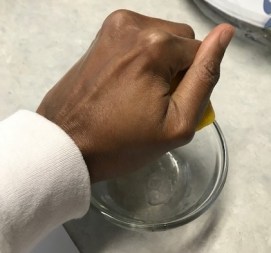
Squeeze a lemon into a bowl

Write your secret message on the paper in lemon juice using a paintbrush or cotton swab.

Draw quickly in order to check your work before it dries. It does not have to be as dark as the picture below. My son insisted on going over the numbers numerous times so he could see it.

To get the message, an adult should iron the paper with a hot iron until the message comes through

Warning:

  • This activity may stain your iron with brown spots. This happened to me. I was able to get my iron squeaky clean by following the video below.

Why this activity Works:

  • This works because lemon juice is an acid.
  • When it is put on the paper, the acid destroys some of the paper surface.
  • When you heat it up with the iron, the areas with the message turn brown first.
  • Milk also works with this activity because it is slightly acidic.

Have fun with this simple activity!

OUR KID FRIENDLY FAST & FUN STUDY TRICKS FOR BETTER GRADES: 9 FUN STRATEGIES FOR SUCCESS IN LEARNING AND SCHOOL HAS $29 OFF THE ORIGINAL PRICE.

Our books are available on Amazon, “Teach Your Toddler to Read Through Play,” “Fun Easy Ways to Teach Your Toddler to Write, and “Teach Your Child About Money Through Play.

THE TEACH YOUR TODDLER TO READ THROUGH PLAY ONLINE COURSE HAS A $97 DISCOUNT.

Click here for the PAYMENT PLAN OPTION!

Car Wash Fun for Kids – The Ultimate Learning Activity

My son loves to play, build, and race his toy cars. One day, I asked him if he wanted to have a car wash after seeing this activity on the Internet. I remember looking at this activity and thinking this would be a great idea for a kid who likes cars.

I had several reasons for suggesting the car wash. First, this activity was a fun way to encourage my son to practice his penmanship. The weekend we did the activity, it was raining. I was trying to find something hands-on to do in the house; although, a car wash is really fun when doing it outside on a sunny day. Furthermore, I wanted to incorporate three things that interest my son which are cars, counting, and getting messy.

Our Car Wash incorporated fun and so many aspects of hands-on learning. I thought I would share this activity with you so your kids can have as much fun as my son.

Check out our new book available on Amazon, Teach Your Child About Money Through Play! It has over 110 Games/Activities, Tips, and Resources. The book is great for kids ages 4-10 and their parents.

Let’s Get Started

Materials:

  • Big sheet of poster board or white craft paper
  • Toy Cars
  • Markers
  • Painters Tape
  • Towels (3)
  • Wash Cloth
  • Cash Register or Play Money (You may also make your own play money)
  • Two Rectangular Plastic Containers
  • Water
  • Dish Detergent
Some of the materials for the Car Wash

Preparation:

  • Have your child decide the Car Wash Prices.
  • If your child can write, have them write the car wash prices on the poster board or white craft paper.
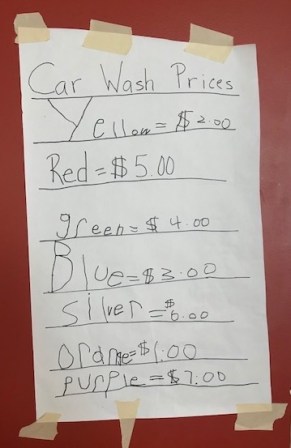
  • My son decided to give each color car a different price.
  • If your child can’t write, you may create the Car Wash Price Sign for them.
  • You may have your child draw the various colored cars on the sign.
  • I created a template on construction paper to assist my son in organizing the Car Wash prices on the white craft paper.
My son writing the Car Wash Prices using the template I created on pink construction paper.
Continuing to write the prices
Car Wash Price Sign is complete.
  • Tape the Car Wash Prices to a wall where it is visible for customers.
Car Wash Prices taped to the wall.
  • Get the toy cars, cash register, wash cloth, and towels
  • Lay the towels on the floor if you are doing this in your home.
  • If you are outside, then you can skip this step.
  • Fill one rectangular plastic container with dish detergent and water halfway.
  • This is where you will wash the cars
  • Fill the other rectangular plastic container with water.
  • This is where you will rinse the cars.

Now the Car Wash can Begin!

  • Have your child role play the Car Wash owner.
  • You or your child’s siblings and/or friends can play the customers.
  • As a customer, get some play money so you can pay to get your car washed.
  • I started off with $30.00 divided into (10) one dollar bills, (2) five dollar bills, (1) ten dollar bill
My son giving me money to start the Car Wash Activity.
  • Have your child say the following:
  • “Welcome to the Car Wash, how may I help you?
  • You will respond by saying the following…
  • Yes, I would like to have my yellow cars washed please.”
  • Then your child will look at the poster they made to see how much it costs to wash the yellow cars.
  • On our poster, it costs $2.00 to wash the yellow cars.
  • I had three yellow cars, so I gave him $6.00 with (1) five dollar bill and (1) one dollar bill
Exchanging money during the Car Wash Activity
  • Sometimes I gave him more money than the cost of washing the car so he could practice his subtraction skills and give me change.
  • After giving my son the money, he took the cars and washed them.
  • He washed them in the soapy water container and then put them in the container with water to rinse.
  • Next he put them on the towel to dry.
My son washing the cars.
My son rinsing the cars.
  • We kept repeating these steps until all the cars were washed.
  • Another time we did this activity, I was the Car Wash Owner.
  • We have also done this activity where my son was the Cash Wash Owner for the red cars but I was the Cash Wash Owner for the blue cars.
  • In other words, we were alternating roles.
  • Tailor this activity to your child’s ability by doing the following…
    • Have your child wash only one car at a time so they don’t have to do any subtraction or addition.
    • Only give your child one dollar bills so they can practice counting by ones.
    • Make all the car wash prices the same to make things easier.

View the video below to see us do this activity in real time. This video comes from my son’s YouTube channel, Corban’s Fun Learning Activities. Please like and subscribe for fun learning activities.

Subjects Learned in this Activity

Color Recognition

  • Sort the cars by colors.
  • Make different prices for each color car.
  • You may also have a car wash with one color car like the red cars.

Math

  • Adding the costs to wash multiple cars.
  • Subtracting when the customer gives the Car Wash Owner too much money and change is needed.
  • Multiplying the cost when multiple cars with the same price are needed to be washed

Science

  • We had some cars that would float in the water and some that would not
  • We discussed that cars with less density than the water will float.
  • Cars with more density than the water will sink.
  • We reviewed the word buoyancy, which is the ability to float in water.
  • You may discuss the science of soapy water and how it cleans the cars.
    • Soap attaches to dirt and grease and causes it to be pulled off the toy cars and suspended in the water

Writing

  • My son was able to practice his handwriting skills in creating the Car Wash Price Sign.

Customer Service

  • Teach your child the importance of being nice and respectful to their customer.
  • Also ensure your child knows to clean the cars well so the customer is happy.
  • If the customer is happy then they will bring more customers.

Entrepreneurship

  • Explain to your child that Entrepreneurs own businesses and their purpose is to solve problems or make things better.
  • A great business has happy customers who will tell others about their service or product.
  • Take your child to a real Car Wash and show them it is a Real Business.

Have fun with this activity and make this your own!

Don’t forget to check our two books, Teach your Toddler to Read Through Play and Fun and Easy Ways to Teach your Toddler to Write.

Happy Learning!

OUR KID FRIENDLY FAST & FUN STUDY TRICKS FOR BETTER GRADES: 9 FUN STRATEGIES FOR SUCCESS IN LEARNING AND SCHOOL HAS $29 OFF THE ORIGINAL PRICE.

Our books are available on Amazon, “Teach Your Toddler to Read Through Play,” “Fun Easy Ways to Teach Your Toddler to Write, and “Teach Your Child About Money Through Play.

THE TEACH YOUR TODDLER TO READ THROUGH PLAY ONLINE COURSE HAS A $97 DISCOUNT.

Click here for the PAYMENT PLAN OPTION!

Celery Experiment – How Plants Get Water

Spring is here and many kids are helping their parents and teachers grow plants and flowers. One of the most important jobs in growing plants is to water them regularly. My son helps my husband water the garden. As a result, by July, we have vegetables such as cucumbers, tomatoes, and green beans.

This Celery Experiment is great way to show kids how plants get water from their roots up to the leaves. At the end of the post, I will explain why this experiment works.

Let’s Get Started!

Materials:

  • Glass Jar or Drinking Glass
  • Celery
  • Water
  • Food Coloring
  • Knife
Materials for Celery Experiment

Method:

  • Gather the materials
  • Cut about one inch off the bottom of the celery stalk.
Here I cut about one inch off the bottom of the celery.
  • Fill the drinking glass halfway with water.
  • Put a few drops of food coloring into the drinking glass.
Putting drops of food coloring into glass


My son chose to put red and blue food coloring in the glass.
Mixing the food coloring together
  • Place the celery stalk in the colored water and let it sit over night.
We put the celery in the glass
  • Rip open the celery to see how the color travels throughout the stalk
Food coloring on the celery’s rib.
  • You should see that the food coloring has traveled to the leaves.
The food color traveled to the celery’s leaves

Why it works:

  • When you water a plant, the roots absorb the water from the soil.
  • The tiny tubes in the celery or plant stem, called xylem, draw the water up from the roots like a straw.
  • This process is called Capillary Action.
  • Capillary Action happens when water climbs up the tiny tubes.
  • The water droplets stick to the walls of the tubes and go upward.
  • The water sticks to itself and pulls more water as it climbs up.
  • Capillary Action lets water climb up to the various parts of a plant through the xylem tubes in the stem.

Have fun with this experiment!

Don’t forget to check our two books, Teach your Toddler to Read Through Play and Fun and Easy Ways to Teach your Toddler to Write.

Happy Learning!

OUR KID FRIENDLY FAST & FUN STUDY TRICKS FOR BETTER GRADES: 9 FUN STRATEGIES FOR SUCCESS IN LEARNING AND SCHOOL HAS $29 OFF THE ORIGINAL PRICE.

Our books are available on Amazon, “Teach Your Toddler to Read Through Play,” “Fun Easy Ways to Teach Your Toddler to Write, and “Teach Your Child About Money Through Play.

THE TEACH YOUR TODDLER TO READ THROUGH PLAY ONLINE COURSE HAS A $97 DISCOUNT.

Click here for the PAYMENT PLAN OPTION!